12 min read2 viewsAuthorOpenSEO Team

AI for Keyword Research: Unlock Deeper User Intent

AI for Keyword Research: Unlock Deeper User Intent

Is your current keyword strategy feeling like a shot in the dark, missing the mark in today's AI-powered search landscape? If you're ready to move beyond surface-level keywords and truly connect with your audience, the future of SEO is here. In 2025, understanding the why behind every search query is paramount, and AI is your most powerful ally. This guide will reveal how to harness the transformative capabilities of AI SEO tools to unlock deeper user intent, pushing your content to the forefront of search results. Prepare to transform your visibility and drive significant growth in the US market. We'll explore how AI is fundamentally altering search behavior, introduce intent-first keyword mapping, showcase essential AI SEO tools, equip you for competitive analysis, and uncover lucrative hidden opportunities, all tailored for the evolving 2025 search environment.

Understanding the AI Shift: Beyond Keywords to Context

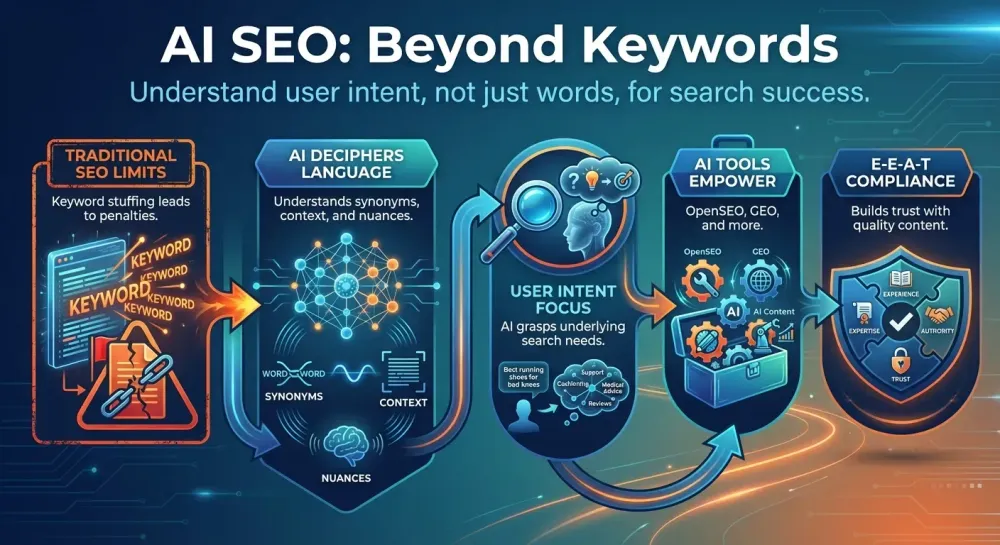
The landscape of search is undergoing a profound transformation, moving beyond simple keyword matching to a nuanced understanding of user intent. This "AI Shift" is fundamentally reshaping how we approach online visibility and content strategy. The integration of artificial intelligence into search engines and content creation tools means that grasping the underlying meaning of queries is now paramount. This evolution necessitates a strategic shift for businesses and marketers alike, moving from a purely keyword-driven approach to one that prioritizes contextual relevance and user intent.

How AI Interprets Search Queries: NLP and Semantic Understanding

At the heart of this shift lies Natural Language Processing (NLP) and semantic understanding. AI-powered search engines are no longer just scanning for specific words; they are interpreting the relationships between those words, the sentiment behind the query, and the broader context of what the user is trying to achieve. This allows for a much more sophisticated interpretation of search queries, leading to more accurate and relevant results. Tools like ChatGPT and Jasper AI are at the forefront of this revolution, transforming how we approach content creation by enabling the generation of human-like text that aligns with these deeper semantic understandings. This means that simply stuffing keywords into content is becoming increasingly ineffective.

The Impact of AI Overviews and Generative Search on Visibility

The emergence of AI Overviews and generative search experiences presents both opportunities and challenges for online visibility. These features, which often provide direct answers or summaries at the top of search results, can significantly alter click-through rates. Understanding user intent becomes even more critical, as the goal is no longer just to rank, but to be the source that AI pulls from for its answers. This necessitates a focus on creating authoritative, comprehensive, and contextually rich content that AI systems can readily understand and trust.

Why Traditional Keyword Volume is No Longer Enough

The era of relying solely on keyword volume for SEO success is rapidly fading. While keyword research remains a foundational element, the emphasis has shifted towards intent analysis. Search engines are becoming adept at understanding the "why" behind a search, not just the "what." This means that content must be crafted to directly address the user's underlying need or question. Leading AI SEO tools are now integrating advanced AI features, with platforms like Semrush and Ahrefs providing deeper insights into search behavior, user intent patterns, and the semantic relevance of content. This allows for a more strategic and effective approach to SEO in an AI-driven world.

Intent-First Keyword Mapping: The Core of AI SEO

In the evolving landscape of search, understanding why a user is searching is paramount, moving beyond mere keyword identification. This core principle is the bedrock of effective AI SEO, where sophisticated AI SEO tools help decipher user intent to craft content that truly resonates. Prioritizing user intent ensures your content not only appears in search results but also satisfies the user's underlying need, driving engagement and conversions.

Defining the Four Types of User Intent

User intent broadly falls into four categories: Informational (seeking knowledge), Navigational (looking for a specific website), Transactional (ready to buy), and Commercial (researching before a purchase). Identifying these distinctions is crucial. For instance, a query like "best AI SEO tools" signals commercial intent, prompting a comparison of features and pricing, while "how to use AI SEO tools" leans towards informational.

Practical Implications & Actionable Tips:

  • Informational Intent: Users want to learn. Focus on creating comprehensive guides, blog posts, and FAQs that answer their questions thoroughly.
    • Tip: Use AI to identify common questions related to your core topics and build content around them.
  • Navigational Intent: Users know where they want to go. Ensure your website is easily discoverable and your brand is prominent.
    • Tip: Optimize your website's meta titles and descriptions to clearly indicate your brand and offerings.
  • Transactional Intent: Users are ready to buy. Make the path to purchase as seamless as possible with clear calls to action and optimized product pages.
    • Tip: Leverage AI to analyze competitor product pages and identify elements that drive conversions.
  • Commercial Intent: Users are researching before a purchase. Provide detailed comparisons, reviews, and pricing information.
    • Tip: Create comparison articles and in-depth reviews that highlight your unique selling propositions.

Identifying Intent Signals in Search Queries

Recognizing intent signals within search queries is where AI SEO tools truly shine. These tools analyze patterns and linguistic cues. For example, the presence of words like "buy," "price," or "discount" strongly indicates transactional intent. Conversely, questions beginning with "what," "how," or "why" typically point to informational intent. Analyzing SERPs for different intents reveals Google's preferences: blog posts and guides dominate informational queries, while product pages and listings are favored for transactional searches. Tools like Google Search Console are invaluable for analyzing query patterns and inferring user intent, helping you align your content strategy.

Aligning Content with Intent for Maximum Impact in 2025

To achieve maximum impact in 2025, tailoring your content format and messaging to match the specific intent behind a keyword is non-negotiable.

Intent Type User Goal Content Format Examples
Informational Learn about a topic Blog posts, guides, FAQs, infographics
Navigational Find a specific website or page Direct links, branded content
Transactional Make a purchase Product pages, landing pages, checkout flows
Commercial Research products/services before buying Comparison articles, reviews, case studies, pricing pages

By strategically mapping keywords to intent and crafting content that directly addresses user needs, you leverage the power of AI SEO tools to enhance visibility and drive meaningful results.

Leveraging AI Tools for Advanced Keyword Discovery

In today's dynamic digital landscape, staying ahead of search engine algorithms and user intent requires sophisticated tools. Artificial intelligence is revolutionizing how we approach keyword research, moving beyond simple volume metrics to uncover deeper insights. By harnessing the power of AI, marketers can gain a competitive edge, identifying not only what users are searching for now but also what they will be searching for in the future. This section delves into how advanced AI SEO tools can elevate your keyword discovery strategy.

Top AI SEO Tools for the US Market: Semrush, Ahrefs, and Beyond

Established leaders like Semrush and Ahrefs have integrated powerful AI-driven features into their platforms, offering a robust suite of AI SEO tools. These platforms excel at analyzing vast datasets to reveal keyword opportunities, competitor strategies, and content gaps. Beyond these giants, specialized AI keyword research tools are emerging, providing unique perspectives and deeper dives into niche areas. For instance, tools leveraging natural language processing can interpret search intent with greater accuracy, suggesting long-tail keywords that might otherwise be overlooked. Exploring these AI SEO tools allows for a more nuanced understanding of the US market's search behavior.

AI SEO Tool Core AI Functionality Unique Selling Proposition
Semrush Topic Research, Keyword Magic Tool Comprehensive market analysis and competitor insights
Ahrefs Content Explorer, Keywords Explorer Focus on content-driven keyword discovery and backlink analysis
MarketMuse Content Intelligence AI-driven content optimization and topic authority building
Surfer SEO Content Editor On-page optimization based on AI analysis of top-ranking content

Uncovering Semantic Relationships and Topic Clusters with AI

AI's ability to understand context and semantic relationships is a game-changer for building authority. Instead of just identifying individual keywords, AI can group related terms into comprehensive topic clusters. This approach allows for the creation of in-depth, authoritative content that fully addresses user queries. By using AI SEO tools to map out these semantic connections, you can ensure your content covers a subject from all angles, significantly boosting your website's relevance and ranking potential. This systematic approach to content development is crucial for establishing thought leadership.

The future of SEO lies in anticipating user needs. AI-powered predictive analytics can identify nascent keyword trends and shifts in search behavior before they become mainstream. By monitoring these emerging topics and leveraging predictive data, businesses can proactively create content that aligns with future search demand. This foresight, powered by advanced AI SEO tools, ensures that your SEO strategy remains relevant and effective, especially as we look towards 2025 and beyond. Staying ahead of the curve means not just reacting to current trends but shaping future search conversations.

Leveraging advanced AI SEO tools is paramount for unlocking competitive advantages. By meticulously analyzing competitor content and keyword strategies, businesses can pinpoint underserved areas within their niche. This strategic approach allows for the identification of unique opportunities that larger, more established players may overlook, paving the way for targeted growth and increased visibility.

Identifying Keyword Gaps with AI-Powered Competitor Analysis

Sophisticated AI SEO tools excel at dissecting competitor landscapes. They can reveal not just the keywords rivals are targeting, but also the content formats they employ and the search intent they address. This deep dive allows for the identification of crucial keyword gaps – phrases and topics that competitors are neglecting, yet which hold significant potential for audience engagement. By understanding these underserved areas, businesses can craft content that directly addresses these unmet needs, positioning themselves as authoritative resources.

The Strategic Value of Zero-Volume and Low-Volume Keywords

A key insight unearthed by advanced AI SEO tools is the strategic value of zero-volume and low-volume keywords. While seemingly insignificant, these terms can represent highly specific, high-intent search queries. Users typing these phrases often have a very clear objective, leading to higher conversion rates. For instance, a niche artisanal coffee roaster might find low-volume keywords related to specific bean origins or brewing methods that larger competitors ignore. Mastering these opportunities allows for efficient resource allocation and a focused approach to capturing valuable, albeit smaller, segments of the search market.

Mastering Long-Tail and Conversational Keywords for Niche Targeting

AI's ability to understand natural language perfectly aligns with the rise of long-tail and conversational keywords. These longer, more descriptive phrases mimic how people naturally ask questions and express their needs. By optimizing for these terms, businesses can attract highly qualified traffic. For example, instead of targeting "SEO tools," one might target "best AI SEO tools for small businesses to improve local search." Tools like Ubersuggest, or specialized AI features within broader platforms, are instrumental in uncovering these niche, conversational terms, enabling precise targeting and deeper audience connection within specific market segments.

FAQ (Frequently Asked Questions)

Q1: How does AI change the way we do keyword research?
A1: AI transforms keyword research by moving beyond simple volume metrics to focus on understanding user intent, semantic relationships, and predictive trends. It helps identify the why behind searches, enabling more targeted and effective content creation.

Q2: What are the main benefits of using AI SEO tools for keyword research?
A2: AI SEO tools offer benefits such as uncovering deeper user intent, identifying niche opportunities, analyzing competitor strategies more effectively, discovering emerging keyword trends, and building comprehensive topic clusters for improved authority.

Q3: Can AI help me understand what my competitors are doing with their keywords?
A3: Absolutely. AI SEO tools can perform in-depth competitor analysis, revealing their targeted keywords, content formats, and the search intent they are addressing, thus highlighting keyword gaps you can exploit.

Q4: Is it still important to consider keyword volume when using AI for keyword research?
A4: While keyword volume was once king, AI shifts the focus to intent. High-volume keywords are still relevant, but AI helps prioritize terms with high intent, including valuable low-volume and long-tail keywords that may have higher conversion rates.

Conclusion: Embrace the AI Revolution for Unrivaled Keyword Mastery

As 2025 unfolds, the paradigm of keyword research has irrevocably shifted, thanks to the transformative power of AI. We've moved beyond superficial metrics, delving into the nuanced world of deep user intent and contextual understanding. The era of simply identifying high-volume keywords is over; the future belongs to those who leverage intelligent AI SEO tools to truly grasp what their audience is searching for. This evolution empowers you to connect with users on a profound level, delivering content that resonates and satisfies their underlying needs.

To thrive in this dynamic landscape, begin by critically auditing your existing keyword strategy through the lens of user intent. Don't hesitate to experiment with cutting-edge AI-powered tools. These powerful allies can unveil hidden niche opportunities and provide the insights necessary to refine your content creation approach with unparalleled precision. Furthermore, consistently analyze your competitors' strategies, adapting your own to stay ahead of the curve. The AI-driven SEO revolution is here, and embracing it is no longer an option, but a necessity for lasting success.

Ready to unlock deeper user intent and dominate search in 2025? Don't be left behind. Explore our advanced AI-powered SEO solutions today and equip yourself with the intelligence to truly connect with your audience, or subscribe now for a continuous stream of cutting-edge strategies that will propel your digital growth.