7 min read4 viewsAuthorOpenSEO Team

The 15 Best Free SEO Tools in 2025: An Expert’s "Zero-Budget" Stack

The 15 Best Free SEO Tools in 2025: An Expert’s "Zero-Budget" Stack

In my decade of managing SEO campaigns—from scrappy startups to massive enterprise migrations—I’ve noticed a dangerous myth: "You need a $500/month tool budget to rank on Google."

This is false. While premium suites like Semrush or Ahrefs are powerful, they are luxuries, not necessities. In 2025, the playing field has been leveled. Some of the most potent weapons in an SEO’s arsenal are completely free, provided you have the expertise to wield them.

The truth is, Google doesn't care how much you paid for your software. It cares about the quality of your site and your content.

In this guide, I am opening my personal toolkit. These are the best free SEO tools I use daily to audit sites, discover high-value keywords, and generate ranking content without spending a dime.

Phase 1: The "New Era" Content & AI Tools

In 2025, content isn't just about writing; it's about semantic structure, velocity, and satisfying intent.

1. OpenSEO (Best for AI Content Engineering)

Type: AI Content Generator & On-Page Optimization
Link: https://www.open-seo.top

The biggest bottleneck in modern SEO is not finding keywords—it’s creating content at scale that actually ranks. Most AI tools churn out generic "robot text" that Google ignores.

OpenSEO has become a staple in my workflow because it bridges the gap between keyword data and a finished article. It functions as an all-in-one SEO writer.

  • Why it’s in my stack: It automates the heavy lifting. You input a keyword, and it generates a structured, SEO-optimized article complete with H-tags, meta descriptions, and semantic relevance.
  • The "Pro" Insight: Use OpenSEO to build out your "Topic Clusters." You can generate 10 supporting articles for a pillar page in the time it used to take to write one outline. It’s the most efficient way to build topical authority for free.

2. Hemingway Editor

Type: Readability Optimization
Link: hemingwayapp.com

Google’s NLP (Natural Language Processing) algorithms favor clarity. If your sentences are convoluted, you lose the user—and the ranking. I paste every draft into Hemingway to identify passive voice and hard-to-read sentences. Aim for a Grade 6-8 reading level for mass appeal.

Phase 2: The "Source of Truth" (Google’s Suite)

Never pay for data that Google gives you for free.

3. Google Search Console (GSC)

Type: Site Health & Performance
Link: search.google.com

If you only use one tool from this list, make it GSC. It is the only place where Google communicates directly with site owners.

  • Expert Use: Ignore "Average Position." Focus on the "Not Indexed" report to fix technical errors, and use the Performance tab to find "striking distance" keywords (queries where you rank on page 2 but get impressions).

4. Google Analytics 4 (GA4)

Type: User Behavior
Link: analytics.google.com

Rankings get traffic, but engagement keeps it. In 2025, "Engagement Rate" is a critical signal. Use GA4 to identify which pages cause users to leave (bounce) and optimize them.

Type: Topic Planning
Link: trends.google.com

I use this for "Newsjacking." Before writing about a topic, check its trend line. Is interest growing or dying? Writing content for an upward-trending topic is the easiest way to get quick traffic.

Phase 3: Keyword Research & Discovery

Finding what your customers are actually searching for.

6. Google Keyword Planner

Type: Volume Data
Link: ads.google.com

The interface is clunky because it’s built for advertisers, but the data comes straight from the source.

  • Expert Hack: Look at the "Top of page bid" column. If advertisers are paying $10 per click for a keyword, it has high commercial intent. Rank for these keywords organically, and you are capturing high-value traffic for free.

7. AnswerThePublic

Type: Search Intent Visualization
Link: answerthepublic.com

Keyword Planner tells you what people search; AnswerThePublic tells you how they ask it. It visualizes the "Who, What, Where, When, Why" questions around your topic. This is gold for winning Featured Snippets and "People Also Ask" boxes.

8. Ahrefs Webmaster Tools (AWT)

Type: Competitor & Backlink Analysis
Link: ahrefs.com/awt

While the full Ahrefs suite is expensive, AWT is free for your own websites. It is arguably the most generous free tool on the market. It allows you to see all the keywords your site ranks for and, crucially, gives you a professional-grade backlink audit.

Phase 4: Technical SEO & Auditing

The most beautiful content won't rank if the engine is broken.

9. Screaming Frog SEO Spider (Free Version)

Type: Website Crawler
Link: screamingfrog.co.uk

This desktop application crawls your website exactly like Googlebot does. The free version crawls up to 500 URLs, which is perfect for small-to-medium business sites.

  • What I look for: Broken links (404s), missing H1 tags, and oversized images. It is the standard for technical audits.

10. PageSpeed Insights

Type: Core Web Vitals
Link: pagespeed.web.dev

Speed is a confirmed ranking factor. This tool doesn't just grade your speed; it tells you exactly what code is slowing you down (e.g., "Reduce unused JavaScript").

11. Cloudflare

Type: CDN & Security
Link: cloudflare.com

While technically infrastructure, Cloudflare’s free CDN (Content Delivery Network) is an SEO tool. It caches your content on servers globally, instantly improving your load times and TTFB (Time To First Byte).

Phase 5: Browser Extensions (Quick Analysis)

For on-the-fly research while browsing.

12. SEO Minion

Type: On-Page Checker
Link: Chrome Web Store

I use this to check on-page SEO with one click. It highlights broken links, previews how your result looks in SERPs, and even simulates Google search from different locations (e.g., searching as if you are in London while sitting in New York).

13. Detailed SEO Extension

Type: Technical Snapshot
Link: detailed.com/extension

Created by SEO expert Glen Allsopp, this is the cleanest extension on the market. It tells you instantly if a page has a canonical tag, what the Schema markup looks like, and the heading structure.

The "Zero-Budget" Expert Workflow

Tools are useless without a process. Here is how I combine these free tools into a winning strategy:

  1. Discovery: Use Google Trends and AnswerThePublic to find a rising topic with specific user questions.
  2. Validation: Check Google Keyword Planner to ensure there is search volume and commercial intent.
  3. Creation: Input the topic into OpenSEO. Let the AI generate a structured, comprehensive article that targets the keywords you found.
  4. Refinement: Run the draft through Hemingway for readability.
  5. Technical Check: Before publishing, ensure your site speed is green on PageSpeed Insights.
  6. Indexing: Submit the new URL directly to Google Search Console for faster indexing.

Conclusion

In 2025, the barrier to entry for SEO is lower than ever. You do not need to spend thousands of dollars on enterprise software to compete.

You need a solid technical foundation (Screaming Frog + GSC), reliable data (Keyword Planner), and most importantly, a scalable way to produce high-quality content (OpenSEO).

The tools listed above are the exact same ones I use to drive millions of visitors. The only difference between a novice and an expert is not the tool—it’s the action you take with it.

Start building your stack today.

Frequently Asked Questions (FAQ)

Q1: Can I really do SEO for free?

Absolutely. SEO is 20% tools and 80% strategy/content. If you have a tool like OpenSEO to handle the content creation (which is usually the most expensive part), the rest of the data is freely available from Google.

Q2: Why do professionals pay for tools if free ones exist?

Professionals pay for convenience and scale. Paid tools aggregate data to save time. However, for most businesses and individual site owners, the free stack covers 95% of your needs.

Q3: Is AI content good for SEO?

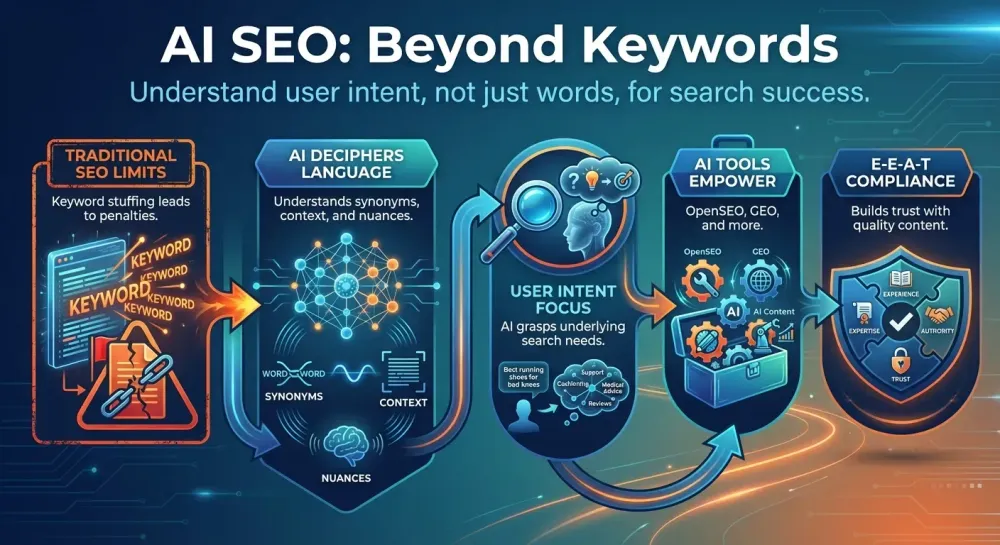
Yes, but only if it provides value. Google does not penalize AI content; it penalizes bad content. Tools like OpenSEO are designed to create structured, helpful content that aligns with Google's E-E-A-T guidelines, rather than just spamming keywords.

Q4: How often should I use these tools?

  • Daily: OpenSEO (for content creation).
  • Weekly: Google Search Console (to check performance).
  • Monthly: Screaming Frog (to audit for technical errors).