AI SEO: Rethink Content Strategy Beyond Keywords in 2026

The Shifting Sands: Why Traditional Keyword SEO Is No Longer Enough
The landscape of search engine optimization (SEO) is undergoing a profound transformation, moving beyond simple keyword matching to embrace a more nuanced understanding of user needs. This evolution is largely driven by the increasing sophistication of search algorithms and the advent of advanced AI technologies. As search engines strive to deliver more relevant and comprehensive results, a purely keyword-centric approach is proving insufficient.
The Evolution of Search: From Keywords to Intent
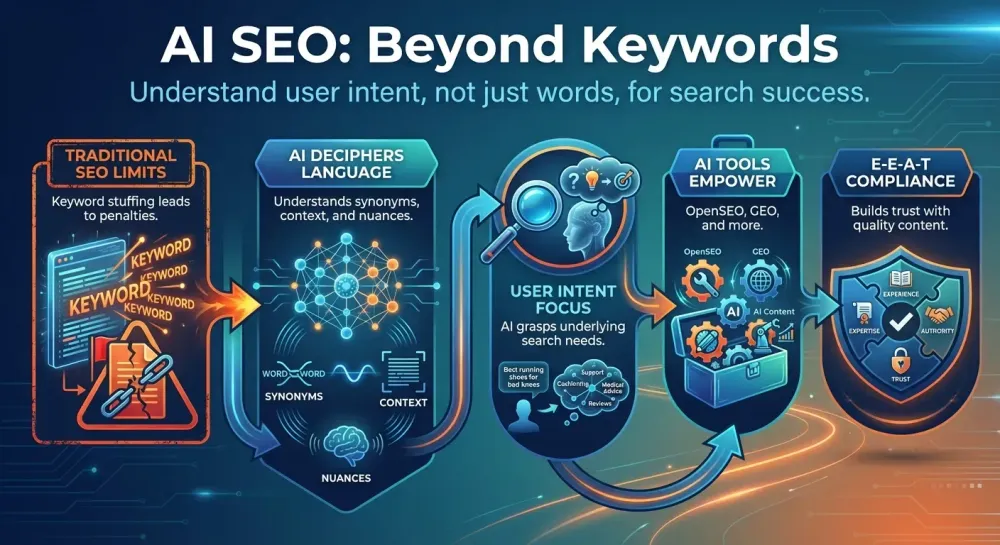
Search engines are no longer merely matching exact keywords. They are increasingly focused on understanding the underlying user intent and the broader context of a query. Tools like OpenSEO exemplify this shift by offering smart keyword research that uncovers high-potential, low-competition long-tail keywords, ensuring content aligns with what users are truly looking for. This move from keyword stuffing to intent-driven content creation is crucial for modern AI SEO.
The Rise of Generative AI in Search
Generative AI, exemplified by models like ChatGPT and Gemini, is fundamentally altering how users seek information. Instead of fragmented searches, users are now posing more natural, conversational queries, expecting comprehensive, well-structured answers. This necessitates content that goes beyond superficial keyword inclusion to provide genuine value and depth, a capability that advanced AI SEO solutions aim to facilitate.
Limitations of the Keyword-Centric Approach in the AI Era
An over-reliance on exact-match keywords can result in content that feels robotic, lacks depth, and fails to satisfy complex user needs. As AI algorithms become more adept at discerning content quality, they can detect and penalize thin, keyword-stuffed pages. This makes a comprehensive, AI-assisted approach to AI SEO, which prioritizes semantic understanding and user experience, indispensable for sustained visibility.
Introducing AI SEO: A New Paradigm for Content Strategy
The landscape of search engine optimization is undergoing a profound transformation, driven by the integration of artificial intelligence. AI SEO is not merely about adopting new tools; it represents a fundamental strategic shift in how we conceive, create, and optimize content for digital visibility. This evolution promises to redefine how users discover information and how brands establish their presence in an increasingly intelligent digital ecosystem.
Defining AI SEO: Beyond Automation
AI SEO signifies a move beyond simple automation. It's about leveraging AI’s analytical and generative capabilities to deeply understand user intent, enhance semantic relevance, and ensure content depth. Tools like OpenSEO exemplify this shift, offering not just content generation but intelligent keyword research and detailed article scoring. This approach ensures that content is not only created efficiently but is also inherently optimized for discoverability by both traditional search engines and emerging AI platforms.
The Core Pillars of AI SEO
The effectiveness of AI SEO rests on several key pillars. These include a sophisticated understanding of user intent, ensuring content directly addresses searcher needs. Semantic relevance is paramount, meaning content must be contextually rich and interconnected. Content depth, providing comprehensive and authoritative information, is crucial. Finally, technical optimization remains a foundational element, ensuring that AI-generated content is structured and presented in a way that AI models can easily process and rank.
GEO (Generative Engine Optimization) and Its Significance
A critical component of this new paradigm is GEO (Generative Engine Optimization). This concept, also referred to as Answer Engine Optimization (AEO), focuses on optimizing content not only for traditional search engines but also for generative AI platforms like ChatGPT and Gemini. By structuring content with clear semantic relationships and rich data, GEO aims to make brands more discoverable by AI models. This proactive strategy is essential for securing brand visibility within the evolving interfaces of future search, ensuring continued reach and engagement in an AI-first world.
Leveraging AI for Intelligent Keyword Research and Topic Discovery
In today's competitive digital landscape, effective AI SEO strategies go far beyond simply identifying high search volume keywords. Advanced AI tools are revolutionizing how we uncover user intent and discover valuable content opportunities.
Beyond High Search Volume: Uncovering User Intent with AI
AI tools can analyze vast datasets to identify not just what people search for, but why they are searching for it. This deeper understanding allows for more strategic content creation that directly addresses user pain points and questions. Tools like OpenSEO offer intelligent keyword research to uncover high-potential, low-competition long-tail keywords that align with these nuanced user needs.
Long-Tail Keywords in the AI Age: Deeper Insights
AI-powered analysis moves beyond simple keyword volume to strategic topic selection. By delving into user search patterns and behavioral data, AI can pinpoint specific long-tail queries that indicate strong intent. This enables businesses to craft highly targeted content that resonates with niche audiences, driving more qualified traffic and conversions.
AI-Powered Topic Clustering and Content Gap Analysis
Furthermore, AI can help identify content gaps by analyzing competitor strategies and audience discussions across the web. This comprehensive analysis allows for the discovery of underserved topics and questions, empowering content creators to fill these voids and establish authority. This holistic approach ensures that content efforts are not only discoverable but also highly relevant and valuable to the target audience.
AI-Assisted Content Creation: Crafting High-Quality, SEO-Optimized Articles
Leveraging advanced AI models is revolutionizing content creation, enabling the generation of well-structured, logical, and informative long-form articles with remarkable efficiency. This approach significantly streamlines the workflow for content marketers and SEO professionals aiming for enhanced online visibility.
From Prompts to Polished Content: The AI Writing Process
Advanced AI models can generate comprehensive content from simple prompts, laying a strong foundation for articles. Tools like OpenSEO exemplify this, transforming initial ideas into detailed drafts. This process not only accelerates content production but also ensures a consistent and logical flow, crucial for engaging readers and satisfying search engine algorithms. The core benefit lies in achieving high-quality output with minimal human oversight for initial drafts.
Ensuring Readability and Engagement with AI
AI tools are instrumental in refining content for optimal readability and audience engagement. They can suggest improvements to sentence structures, vocabulary, and overall tone, ensuring the article resonates with the target audience. This intelligent assistance helps bridge the gap between raw AI output and polished, human-like prose, making complex information accessible and enjoyable to consume.
The Role of AI in Structural Optimization (H-tags, Bold Text)
Platforms such as OpenSEO integrate features that automatically optimize content structure. This includes the strategic placement of H-tags (H1, H2, H3, etc.) and the bolding of key phrases. Such automated formatting enhances scannability, allowing readers to quickly grasp the main points and improving the overall user experience, which is a significant factor in AI SEO.
Meeting E-E-A-T Standards with AI Assistance
AI plays a crucial role in helping content creators meet E-E-A-T (Experience, Expertise, Authoritativeness, Trustworthiness) guidelines. By providing factual information, supporting data, and ensuring logical coherence, AI-assisted content can demonstrate a higher level of credibility. This support is vital for building trust with both users and search engines, contributing to better AI SEO performance.
The Power of AI-Driven Content Scoring and Optimization
In today's digital landscape, creating content that resonates with both users and search engines is paramount. AI-driven tools are revolutionizing this process by offering objective, data-backed insights that move beyond subjective guesswork. Platforms like OpenSEO are at the forefront, providing sophisticated AI SEO solutions that empower content creators.
Data-Driven Content Evaluation: Beyond Gut Feelings
Gone are the days of relying solely on intuition for content quality. AI provides objective metrics to evaluate content performance. This shift to data-driven evaluation ensures that optimization efforts are targeted and effective, leading to better search engine rankings and increased organic traffic.
Key Metrics for AI SEO Scoring
OpenSEO's system analyzes crucial factors for AI SEO success. This includes keyword density, ensuring relevant terms are naturally integrated without over-optimization. It also assesses readability through metrics like Flesch-Kincaid scores, making content accessible to a wider audience. Furthermore, content depth is evaluated, ensuring comprehensive coverage of topics.
Actionable Insights for Continuous Improvement
The true power of AI scoring lies in its ability to generate actionable insights. OpenSEO's detailed article scoring provides concrete recommendations for optimizing content before and after publication. This continuous feedback loop allows for iterative refinement, ensuring each piece of content is optimized for maximum impact and discoverability.
OpenSEO's Article Scoring System: A Practical Example
OpenSEO's platform offers a practical example of AI-driven content optimization. By analyzing key metrics, it guides users to refine their articles, ensuring they meet the complex demands of modern search algorithms and user engagement. This intelligent approach to content creation is a game-changer for AI SEO.
Seamless Integration and Workflow Automation with AI SEO Tools
Modern AI SEO tools are engineered for effortless integration into existing content workflows, significantly streamlining the process of optimizing online content.
Bridging the Gap: AI Tools and Content Management Systems (CMS)
The true power of AI SEO lies in its ability to connect with popular platforms. Tools like OpenSEO are designed to work harmoniously with Content Management Systems, eliminating the tedious manual effort of copying and pasting content. This deep integration ensures that AI-generated content can be published directly, saving valuable time for content creators.
The Benefits of WordPress Integration for Content Publishing
For users of WordPress, the integration offered by solutions like OpenSEO is particularly transformative. This seamless connection allows for automated features such as setting featured images, assigning categories, and applying relevant tags. This level of automation is crucial for efficient and scalable content publishing, enabling site owners and marketers to focus on strategic planning rather than repetitive tasks.
Automating Content Updates and Scaling Your Efforts
The automation capabilities provided by AI SEO tools enable businesses to scale their content output dramatically. By handling repetitive tasks, these tools free up human resources to concentrate on higher-level strategy, content ideation, and audience engagement. This shift allows for a more dynamic and responsive approach to SEO and content marketing.
OpenSEO's WordPress Integration: A Streamlined Workflow
OpenSEO exemplifies this seamless integration by offering direct WordPress connectivity. This feature allows users to push AI-generated articles directly to their WordPress site with a single click, automatically configuring essential elements like featured images, categories, and tags. This streamlined workflow is a cornerstone of efficient AI SEO practices, making content management more agile and effective.
The Future of Search: Embracing AI SEO for Long-Term Growth
The landscape of search is rapidly transforming, with AI SEO emerging as a cornerstone for sustained online success. Embracing these advancements proactively is crucial for staying ahead.
Anticipating Future Search Engine Updates
Search engines will continue to evolve, with AI playing an increasingly central role in understanding and ranking content. Strategies must adapt to this AI-driven future.
The Competitive Advantage of Early AI SEO Adoption
Adopting AI SEO strategies now provides a significant competitive advantage. Early adopters can leverage AI for deeper insights and automation.
Building a Resilient Content Strategy for the AI Era
A forward-thinking content strategy built on AI principles ensures long-term visibility and relevance. This involves creating content that AI can easily understand and value.
The Role of AI in Personalizing User Experiences
AI can also help in personalizing content delivery, further enhancing user engagement and satisfaction. Tailoring content to individual needs is key.
FAQ (Frequently Asked Questions)
Q1: How is AI SEO different from traditional keyword-based SEO?
A1: Traditional SEO heavily relies on matching exact keywords. AI SEO, on the other hand, focuses on understanding user intent, semantic relevance, and the context of queries, leveraging AI to analyze and generate content that satisfies these deeper needs.
Q2: Can AI completely replace human content creators and SEO experts?
A2: While AI can automate many tasks and assist in content creation, human oversight remains crucial for strategic direction, creativity, nuanced understanding, and ensuring ethical and authentic content that meets E-E-A-T standards. AI is a powerful tool for augmentation, not complete replacement.
Q3: What is GEO (Generative Engine Optimization) and why is it important for AI SEO?
A3: GEO, or Generative Engine Optimization, is the practice of optimizing content for discovery by generative AI platforms. It's important because future search interfaces will increasingly rely on AI to synthesize information, and GEO ensures your content is discoverable and understandable by these emerging AI systems.
Q4: How can tools like OpenSEO help in implementing an AI SEO strategy?
A4: Tools like OpenSEO provide AI-powered features for intelligent keyword research, AI-assisted content creation, structural optimization, and data-driven content scoring. They streamline the workflow, offer actionable insights, and facilitate seamless integration with platforms like WordPress, making AI SEO implementation more accessible and effective.
Conclusion
The landscape of search is undergoing a profound transformation, and by 2026, the era of AI SEO will be undeniably dominant. As we've explored, clinging to outdated keyword-stuffing tactics is a surefire path to obsolescence. The true power of AI SEO lies in its ability to shift our focus from mere keywords to the intricate tapestry of user intent. This means crafting content that is not just informative, but truly comprehensive, valuable, and capable of satisfying complex queries across both traditional search engines and the rapidly expanding realm of generative AI.
Embracing AI SEO is no longer an option; it's a strategic imperative for survival and success. Tools like OpenSEO exemplify this revolution, offering integrated solutions that empower intelligent keyword research, streamline AI-assisted content creation, and provide the data-driven optimization necessary to thrive. To secure your place in this evolving search ecosystem, adopt an AI SEO mindset today. Start by integrating AI-powered research tools into your workflow, experiment with AI-assisted content ideation and generation, and prioritize creating deeply valuable, user-centric content. Don't wait for the future of search; actively shape it by adopting AI SEO and building content strategies that resonate with both users and AI, ensuring your visibility and impact for years to come.