AI SEO vs Traditional SEO: Adapt Your Strategy for 2025

This article will equip you with the knowledge to navigate this evolving landscape. We'll break down the core differences between AI SEO and traditional SEO, illuminate the distinct benefits of embracing AI-powered strategies, and provide actionable steps to future-proof your online presence. Prepare to discover how cutting-edge tools are paving the way for unprecedented visibility and traffic in the age of intelligent search.
The Shifting Sands of Search: AI SEO vs. Traditional SEO
The landscape of search engine optimization is undergoing a seismic shift, driven by the rapid integration of artificial intelligence. Understanding this evolution is crucial for maintaining online visibility.
Understanding the Evolution of Search Engines
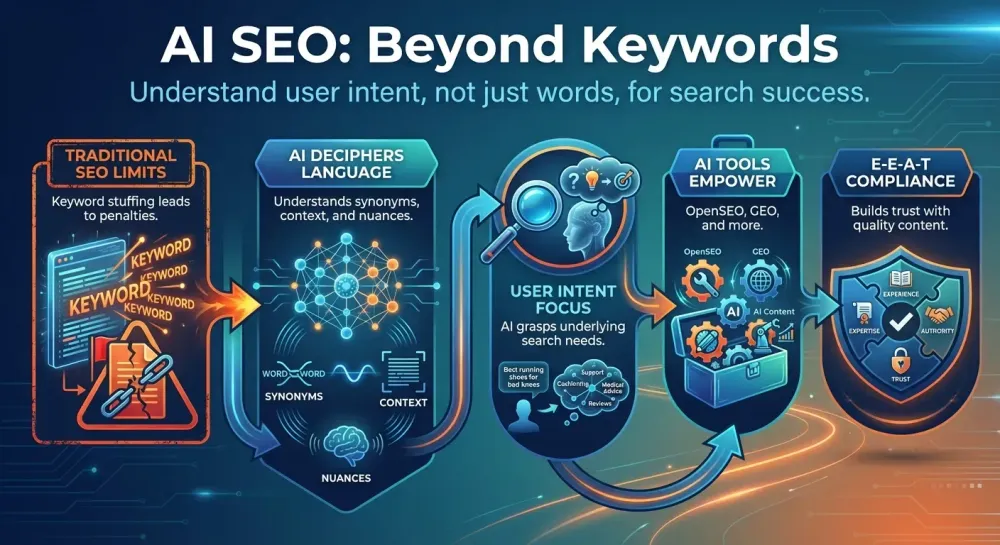
Search engines are moving beyond simple keyword matching. Algorithms now prioritize understanding user intent and the semantic meaning of content. This fundamental change is reshaping how websites are discovered and ranked, ushering in a new era of AI SEO.
What is Traditional SEO and Its Core Principles?
Traditional SEO focused on tactics like keyword research, on-page optimization (meta descriptions, headings), off-page optimization (link building), and technical SEO (site speed, mobile-friendliness). While these elements remain important, their impact is being recontextualized by AI.
The Dawn of AI SEO: Redefining Search Visibility
AI SEO encompasses optimizing for AI-driven search, including generative AI and conversational search. Tools like OpenSEO are emerging to help content creators navigate this new paradigm. OpenSEO, for instance, offers intelligent keyword research and AI-powered article generation, focusing on creating content that resonates with both users and AI algorithms. Their approach to Generative Engine Optimization (GEO) specifically targets how AI interprets and recommends content, aiming to capture future search traffic.
Key Differences: How AI SEO Changes the Game
The primary shift is from keyword exactness to semantic understanding and user intent. AI search results are also evolving, with featured snippets and AI-generated answers becoming more prominent. This means content needs to be not just keyword-rich but also comprehensive, authoritative, and directly address user queries.
| Aspect | Traditional SEO | AI SEO |
|---|---|---|
| Focus | Keyword matching, backlinks | User intent, semantic understanding, AI interaction |
| Content | Keyword density, on-page elements | Depth, authority, conversational tone |
| AI Impact | Minimal direct optimization | Core strategy, optimizing for generative AI |
| Result Types | Ranked lists | Featured snippets, AI-generated answers |
Leveraging AI for Smarter Keyword Research and Content Ideation
In today's evolving digital landscape, AI is fundamentally transforming how we approach SEO. Tools are moving beyond basic volume and competition metrics to offer deeper, more actionable insights. This shift empowers content creators and marketers to refine their strategies for maximum impact.
Beyond Basic Keyword Tools: AI-Powered Insights
AI enhances SEO by automating keyword research, optimizing content creation, and predicting search trends. Tools like OpenSEO offer intelligent keyword research capabilities that go beyond simple metrics. They uncover high-search, low-competition keywords, providing a significant advantage in the competitive online space. This in-depth analysis helps identify opportunities that might otherwise be missed.
Identifying High-Potential Long-Tail Keywords with AI
Utilizing AI for in-depth keyword analysis is crucial for uncovering hidden opportunities. OpenSEO's platform, for instance, is designed to mine for long-tail keywords that possess strong traffic potential yet face lower competition. This targeted approach ensures that content development is built on a solid foundation of audience interest and search viability.
Understanding User Intent with AI Analysis
The true power of AI in SEO lies in its ability to decipher the "why" behind search queries. By analyzing search patterns and user behavior, AI tools can provide a nuanced understanding of user intent. This allows for the creation of content that not only answers questions but also anticipates user needs, leading to higher engagement and better search engine rankings.
Brainstorming Topics That Resonate with AI and Users
Using AI to generate content ideas that align with both search trends and audience needs is a game-changer. OpenSEO's intelligent solutions help brainstorm topics that are both relevant to current search queries and deeply resonate with the target audience, ensuring content is both discoverable and valuable. This AI-driven ideation process streamlines content strategy and fosters organic growth.
AI-Driven Content Creation: Efficiency Meets Quality
In today's rapidly evolving digital landscape, producing high-quality, SEO-optimized content at scale is paramount. Advanced AI models are revolutionizing this process, offering unprecedented efficiency without compromising on quality. This shift is not just about speed; it's about smarter content creation that resonates with both search engines and human readers.
The Power of Generative AI in Content Production
The capabilities of advanced AI models in generating comprehensive articles are truly transformative. These tools can analyze vast datasets to produce well-researched, detailed content on virtually any topic. This dramatically speeds up the initial drafting phase, allowing content creators to focus on refinement and strategy. Furthermore, AI can assist in brainstorming topics based on target audience interests and identifying emerging search trends, ensuring content remains relevant and discoverable.
Ensuring Readability and Structure with AI Assistance
Beyond raw content generation, AI plays a crucial role in structuring content for optimal readability and search engine understanding. AI assistance can automatically format articles with appropriate H-tags, bolding of key phrases, and a logical flow that guides the reader. This structured approach not only enhances user experience but also makes it easier for search engines to crawl and index content, a vital component of effective AI SEO.
Meeting E-E-A-T Standards with AI-Generated Content
The importance of E-E-A-T (Experience, Expertise, Authoritativeness, Trustworthiness) in search engine rankings cannot be overstated. While AI generates the content, human oversight is essential to imbue it with genuine experience and expertise. AI can support E-E-A-T by providing factual data, citing sources, and ensuring comprehensive coverage of a topic. However, the final layer of authentic experience and authorial voice must come from human editors and subject matter experts.
OpenSEO's Approach to AI-Powered Article Generation
OpenSEO (open-seo.top) exemplifies the intelligent application of AI in content production. Their AI depth article generation focuses on creating structured, readable, and rich content. By integrating smart keyword research, AI-driven article generation with automatic formatting, and a detailed article scoring system, OpenSEO aims to maximize SEO impact. This approach ensures that efficiency gains in content production are directly translated into improved search engine visibility and user engagement, making them a powerful ally in the realm of AI SEO.
Optimizing for Generative AI Engines (GEO) and Future Search
The digital landscape is rapidly evolving, driven by the advent of generative AI. To ensure content remains discoverable and impactful, a new approach to AI SEO is essential. This section explores Generative Engine Optimization (GEO) and its implications for future search.
What is GEO (Generative Engine Optimization)?
GEO, or Generative Engine Optimization, is a specialized subset of AI SEO. It focuses on tailoring content to be understood, recommended, and prioritized by AI models like ChatGPT and Gemini. This involves structuring information to directly answer user queries and providing concise, valuable data that AI can easily process and present.
Adapting Content for AI Chatbots and Assistants
To thrive in the age of AI chatbots and assistants, content must be conversational and direct. Strategies include using clear, natural language, employing question-and-answer formats, and ensuring semantic relevance. OpenSEO, for instance, emphasizes GEO by optimizing content structure and semantic connections, making brands more discoverable by AI recommendation engines.
The Rise of Conversational Search and Its Implications
Conversational search fundamentally changes how users seek information. Instead of keyword strings, users engage in natural language dialogues. This shift necessitates content that is not only keyword-rich but also contextually aware and capable of providing definitive answers, positioning AI as a primary information gatekeeper.
OpenSEO's GEO Optimization Strategies
OpenSEO's GEO optimization strategies are designed to prepare content for this future. By focusing on AI recommendation and future search portals, OpenSEO helps users create content that AI models can readily ingest and serve. This includes leveraging AI for intelligent keyword research, generating deep articles, and utilizing an article scoring system to ensure content meets AI's discerning standards for clarity and depth, thereby enhancing AI SEO performance.
Technical SEO and AI: A Synergistic Relationship
The integration of Artificial Intelligence (AI) is revolutionizing how we approach technical SEO, transforming it from a manual chore into a dynamic, data-driven strategy. AI's ability to process vast amounts of information at speed allows for deeper insights and more efficient optimization, making it an indispensable partner in achieving top search engine rankings. This synergy ensures that websites are not only discoverable by traditional search engines but also optimized for the evolving landscape of AI-powered search.
AI's Role in Technical SEO Audits
AI excels at dissecting website data to pinpoint areas for technical SEO improvement. It can analyze crawl data, server logs, and user behavior patterns to identify issues that might be missed by human auditors. This proactive approach to AI SEO helps ensure a website's underlying structure is sound, facilitating better indexing and ranking.
Automating Technical Issue Detection and Resolution
AI-powered tools can automate the identification of critical technical problems. This includes detecting broken links, identifying crawl errors, optimizing meta tags, and even suggesting improvements for structured data. For instance, OpenSEO's WordPress connector offers seamless integration, allowing for one-click publishing that automates featured images, categories, and tags, thereby streamlining the process of resolving and preventing technical glitches.
The Importance of Site Speed, Mobile-Friendliness, and Indexability in an AI Era
In an era increasingly dominated by AI, foundational technical SEO elements like site speed, mobile-friendliness, and robust indexability are paramount. AI algorithms rely on clean, accessible data to understand and rank content. A slow, poorly structured, or un-indexable site will struggle to be recognized and prioritized by AI, regardless of content quality.
Seamless Integration: OpenSEO's WordPress Connector
The OpenSEO platform exemplifies the practical application of AI in content management and AI SEO. Its WordPress connector is a prime example of automating technical tasks. By enabling one-click publishing, it significantly reduces manual effort, automatically assigning featured images, categories, and tags. This automation not only saves time but also ensures consistency, a critical factor for maintaining technical SEO integrity and enhancing AI discoverability.
Measuring Success in the AI SEO Landscape and Adapting Your Strategy
The advent of AI has fundamentally reshaped the search engine optimization (SEO) landscape, demanding a recalibration of how we define and measure success. Moving beyond traditional keyword rankings, the focus now shifts towards tangible user engagement, conversion rates, and overall AI-driven visibility. This evolution necessitates a proactive approach to strategy, leveraging advanced tools to stay ahead.
Beyond Traditional Metrics: What Matters Now?
In the era of AI SEO, success is no longer solely about ranking position. Instead, key performance indicators (KPIs) are increasingly centered on user behavior. Metrics like time on page, bounce rate, click-through rates from AI-generated summaries, and ultimately, conversion rates, provide a more accurate reflection of content value and user satisfaction. AI's ability to analyze vast datasets allows for a deeper understanding of these engagement signals.
AI-Powered Analytics for Deeper Insights
AI-powered analytics tools offer unprecedented depth in understanding user journeys. They can dissect search patterns, identify emerging user intent, and even predict how users will interact with content. This granular insight allows for more precise optimization, ensuring that content not only ranks but also resonates deeply with the target audience, driving meaningful action.
The Role of AI in Predicting Search Trends
The dynamic nature of search requires foresight. AI excels at analyzing historical data, current conversations, and emerging topics to forecast future search trends. This predictive capability is crucial for adapting your content strategy proactively, ensuring you are creating relevant content before demand peaks and capitalizing on new opportunities in the AI SEO ecosystem.
Developing a Hybrid SEO Strategy for 2025 and Beyond
To thrive in this evolving environment, a hybrid SEO strategy is essential. This approach seamlessly blends time-tested SEO best practices with cutting-edge AI-driven techniques. Tools like OpenSEO exemplify this by integrating AI for keyword research and content generation with robust scoring mechanisms that ensure quality and optimization from the outset.
OpenSEO's Article Scoring for Continuous Improvement
OpenSEO's article scoring system is a prime example of how AI facilitates continuous improvement. Before publication, each piece of content undergoes a detailed evaluation across multiple SEO dimensions, including keyword density, readability, and content depth. This AI-driven feedback loop provides actionable recommendations, empowering creators to refine their work for maximum impact and ensure it meets the high standards of modern AI SEO.
FAQ (Frequently Asked Questions)
Q1: What is the main difference between AI SEO and traditional SEO?
A1: Traditional SEO primarily focuses on keyword matching, backlinks, and on-page optimization. AI SEO, on the other hand, emphasizes understanding user intent, semantic meaning, and optimizing content for AI algorithms and conversational search, aiming to be favored by generative AI engines.
Q2: How can AI improve my keyword research process?
A2: AI can go beyond basic metrics by analyzing vast datasets to uncover high-search, low-competition keywords, identify long-tail opportunities, and understand the nuances of user intent, leading to more effective content targeting.
Q3: Is AI SEO going to replace traditional SEO entirely?
A3: It's unlikely to be a complete replacement. Instead, AI SEO is augmenting and evolving traditional SEO. Core principles like quality content and technical soundness remain crucial, but AI integration is becoming essential for staying competitive. A hybrid approach is recommended.
Q4: What is Generative Engine Optimization (GEO)?
A4: GEO is a specialized form of AI SEO focused on tailoring content to be easily understood, recommended, and prioritized by generative AI models and chatbots, ensuring content is discoverable through conversational search interfaces.
Conclusion
The landscape of search engine optimization has irrevocably shifted; the era of AI SEO is not a speculative future but a present reality, demanding immediate adaptation. While the bedrock of traditional SEO – user intent, technical excellence, and quality content – remains vital, neglecting the transformative power of artificial intelligence is a surefire path to obsolescence.
In 2025, a truly effective strategy must be a hybrid, intelligently integrating AI-driven insights and capabilities with established SEO best practices. This means leveraging AI for hyper-accurate keyword research, generating engaging and relevant content at scale, and optimizing for the increasingly sophisticated algorithms of both traditional search engines and emerging generative AI platforms.
To thrive in this dynamic environment, proactively embrace AI tools. Explore solutions like OpenSEO, which offer a unified platform for intelligent keyword discovery, AI-powered content generation, advanced GEO optimization, and streamlined publishing – empowering you to navigate the complexities of AI SEO with confidence.
Don't just keep pace; lead the charge by integrating AI into every facet of your SEO efforts. Start by experimenting with AI-assisted content ideation and optimization tools today. The ultimate goal remains unchanged: to connect with your audience by delivering exceptional value. Now, with the strategic application of AI SEO, you possess the power to achieve this connection with unprecedented efficiency and effectiveness. Adapt your strategy now and unlock the future of search visibility!