Free SEO Tools: Boost Website Traffic & Rankings

Introduction: The Ever-Evolving Landscape of Website Traffic
Website traffic is the lifeblood of online success, directly impacting visibility, lead generation, and revenue. However, navigating the digital landscape has become increasingly complex, particularly with the constant evolution of search engine algorithms. To thrive, businesses and individuals need accessible and effective SEO strategies. This is where the power of free SEO tools becomes indispensable, leveling the playing field for all. This section will introduce these essential resources and preview the powerful, free tools that will be discussed, offering a pathway to enhanced online presence.
The critical role of website traffic in online success cannot be overstated. The increasing complexity of search engine algorithms necessitates a proactive approach. This highlights the need for effective and accessible SEO strategies. Introducing the power of free SEO tools to level the playing field is paramount. A preview of the essential free SEO tools that will be discussed will empower users to understand their capabilities.
For instance, Google Search Console (GSC) stands out as a premier free SEO tool. As a free alternative, it allows users to meticulously track keyword performance, monitor impressions, analyze clicks, and understand average positions in search results. This direct insight from Google is invaluable for optimizing a website's presence.
Understanding the Foundation: Keyword Research with Free Tools
Embarking on any SEO journey begins with a deep understanding of what your target audience is actively searching for. This is where keyword research becomes your indispensable SEO compass, guiding your content creation and optimization efforts. Without it, you're essentially navigating blindfolded. Fortunately, a wealth of free SEO tools can illuminate the path forward.
Leveraging Google Keyword Planner for Core Insights
Google Keyword Planner, a cornerstone among free SEO tools, offers invaluable data on search volume and competition levels for various keywords. By inputting seed terms related to your niche, you can uncover how many people are searching for specific phrases and how difficult it might be to rank for them. This data is crucial for identifying relevant topics that have a genuine audience.
Exploring Long-Tail Keywords with Free Explorers
Beyond broad terms, discovering niche opportunities lies in exploring long-tail keywords – more specific, multi-word phrases. Tools like Google Search itself (through autocomplete and "People also ask") can act as free explorers for these longer, often less competitive, but highly targeted queries. Understanding the intent behind these searches is paramount; are users looking to learn, buy, or compare? This intent dictates the type of content you should create.
Analyzing Competitor Keywords (with limitations of free tools)
While comprehensive competitor keyword analysis often requires paid solutions, free SEO tools can offer glimpses. Google Search Console, as highlighted by resources like Backlinko, is a powerful free tool for understanding your existing keyword performance. It reveals impressions, clicks, and average positions for terms your site already ranks for, offering insights into what's working and what opportunities you might be missing. For a more streamlined approach to identifying high-search volume, low-competition keywords, platforms like OpenSEO offer intelligent keyword research capabilities. This integration of AI-driven insights within tools like OpenSEO can significantly streamline the process, helping you discover keywords that offer the best potential for organic traffic growth.
Why Keyword Research is Your SEO Compass
Crafting High-Quality Content: AI-Powered Assistance and Optimization
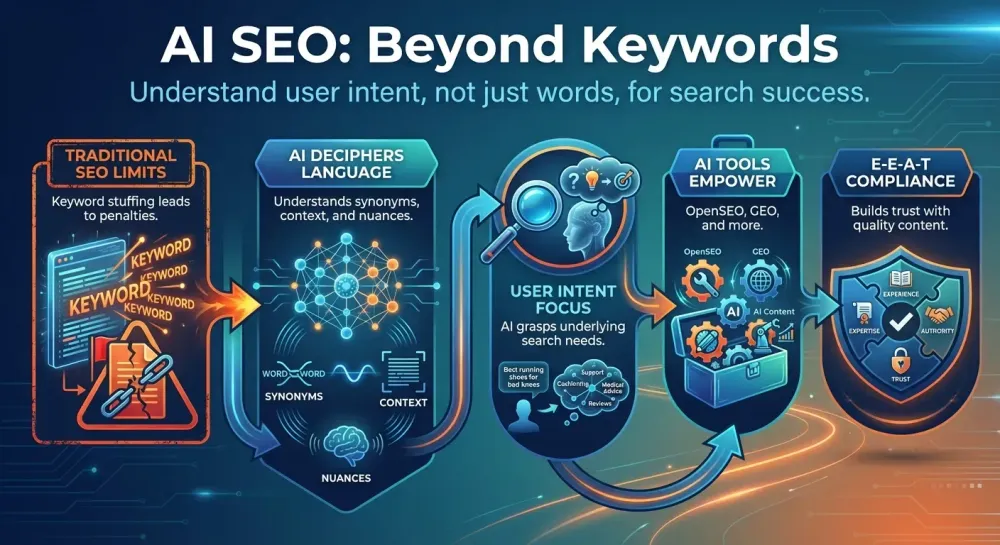
In today's digital landscape, the focus has unequivocally shifted towards creating valuable, user-centric content. This means moving beyond mere keyword stuffing and embracing a strategy where quality reigns supreme. Leveraging advanced tools can significantly streamline this process, ensuring your content not only resonates with readers but also achieves optimal search engine visibility.
The SEO-Content Nexus: Quality Over Quantity
Gone are the days when churning out vast amounts of mediocre content was an effective SEO strategy. Search engines are increasingly sophisticated, prioritizing content that genuinely answers user queries and provides in-depth, authoritative information. This aligns perfectly with the E-E-A-T principles (Experience, Expertise, Authoritativeness, Trustworthiness), which are crucial for building credibility and ranking higher. While direct AI assistance can accelerate content creation, human oversight remains vital to infuse genuine experience and unique insights.
AI Writing Assistants for Efficient Content Creation
AI writing assistants are transforming content creation by drastically reducing the time and resources required. Tools like OpenSEO offer a powerful solution for generating well-structured articles. By inputting a topic or keywords, users can receive AI-generated content that is automatically formatted with H-tags and bolding, enhancing readability. This efficiency allows content creators to focus on refining the message and adding unique value.
Ensuring Readability and Structure
A well-structured article is paramount for both user experience and search engine crawlers. The strategic use of headings (H-tags) and bold text breaks up content, making it easier to scan and digest. This not only keeps readers engaged but also helps search engines understand the hierarchy and key themes of your content. AI tools can automate much of this structural foundation, providing a solid starting point.
Optimizing for Search Engines: On-Page Elements
Beyond content structure, optimizing on-page elements is critical for search engine visibility. This includes crafting compelling meta descriptions that entice users to click and writing clear, keyword-rich title tags. OpenSEO's AI-driven article generation and its integrated SEO scoring system provide invaluable feedback, offering optimization suggestions that can significantly improve your content's chances of ranking well. While free SEO tools are abundant, platforms like OpenSEO integrate advanced AI to streamline the entire creation and optimization workflow, making it easier to achieve top search engine performance.
Technical SEO Essentials: Ensuring Your Website is Search Engine Friendly
A technically sound website forms the invisible backbone of your online presence, directly impacting how search engines like Google discover, understand, and rank your content. Neglecting technical SEO can render your best content invisible, regardless of its quality. Prioritizing these foundational elements is crucial for any successful SEO strategy.
The Invisible Backbone: Technical SEO Explained
Technical SEO involves optimizing your website's infrastructure to improve its crawlability and indexability by search engines. This includes ensuring your site is structured logically, uses clean code, and provides a smooth user experience. While not directly visible to users, these aspects are paramount for search engines to correctly interpret and rank your pages.
Site Speed and Mobile-Friendliness: Crucial Ranking Factors
In today's digital landscape, site speed and mobile-friendliness are non-negotiable. Users expect websites to load instantly and function flawlessly on any device. Google prioritizes these factors, meaning a slow or non-responsive site will significantly harm your search rankings and user engagement. A mobile-responsive design ensures your content is accessible and enjoyable for the vast majority of internet users browsing on smartphones and tablets.
Understanding Your Website's Health with Google Search Console
Google Search Console (GSC) is an indispensable, free SEO tool that offers invaluable insights into your website's performance and health. It allows you to monitor indexing status, identify crawl errors, track keyword performance, and understand how Google sees your site. Regularly checking GSC is vital for proactive SEO management.
Identifying and Fixing Broken Links and Crawl Errors
Using Google Search Console, you can easily pinpoint issues like broken links (404 errors) and other crawl errors. These errors disrupt the user experience and hinder search engine bots from accessing your content. GSC's "Coverage" report, for instance, highlights pages that are not indexed and provides reasons, enabling you to fix them. For instance, identifying a 404 error allows you to redirect the broken URL to a relevant page or fix the link itself.
For seamless content publishing and to simplify these technical aspects, solutions like OpenSEO offer WordPress integration. This allows for a more automated and efficient workflow, ensuring that your content is not only well-optimized but also technically sound upon publication.
Beyond the Basics: Advanced Free SEO Tools and Strategies
Moving beyond fundamental keyword research and on-page optimization, advanced SEO involves a deeper understanding of website authority, competitive landscapes, local reach, and the evolving search ecosystem. While many powerful tools come with a price tag, several free SEO tools offer valuable insights to inform these strategies.
Backlink Analysis: Understanding Your Authority
Backlinks remain a cornerstone of website authority, signaling to search engines that other reputable sites trust your content. While in-depth backlink analysis often requires premium tools, free SEO tools can provide a glimpse. Tools like Google Search Console, a free service from Google, can show you which sites are linking to yours, offering basic insights into your backlink profile. However, free tools have limitations, often showing only a fraction of a site's total backlinks and lacking detailed metrics like link quality or anchor text distribution. Nevertheless, monitoring these free reports can help identify potential link-building opportunities and understand your site's current authority.
Content Gap Analysis: Finding Underserved Topics
Identifying content gaps—topics where competitors are not adequately serving user needs—is crucial for strategic content creation. By analyzing competitor content and search results for relevant queries, you can uncover opportunities to create more comprehensive or unique content. This allows you to attract users who are currently underserved, thereby capturing new traffic and establishing your site as a go-to resource.
Local SEO: Reaching Your Local Audience
For businesses with a physical presence, optimizing for local search is paramount. This involves ensuring your Google Business Profile is complete and accurate, gathering local citations, and encouraging customer reviews. Local SEO strategies help your business appear in "near me" searches and on Google Maps, directly connecting you with potential customers in your geographic area.
The Future of SEO: Generative AI Optimization
The search landscape is rapidly evolving with the rise of generative AI. This shift necessitates a new approach known as Generative Engine Optimization (GEO). GEO focuses on optimizing content not just for traditional search algorithms but also for AI recommendation engines like those powering ChatGPT and Gemini. OpenSEO, for example, champions GEO, helping users create content structured and semantically rich enough to be favored by AI. By focusing on GEO, you can position your content to be recommended by these emerging AI search interfaces, capturing future search traffic before it fully materializes.
FAQ (Frequently Asked Questions)
Q1: What are the most crucial free SEO tools for beginners?
A1: For beginners, Google Search Console and Google Keyword Planner are essential. Google Search Console helps you understand how your site performs in Google Search, while Google Keyword Planner assists in discovering relevant keywords for your content.
Q2: Can free AI writing tools like OpenSEO truly optimize content for search engines?
A2: Yes, AI writing tools like OpenSEO can significantly aid in content optimization. They can generate well-structured content with appropriate headings and formatting, and often include SEO scoring and suggestions to improve your content's search engine friendliness. However, human review and unique insights are still vital.
Q3: How can I improve my website's speed and mobile-friendliness without spending money?
A3: You can use free tools like Google PageSpeed Insights to identify issues affecting your site's speed and mobile usability. Optimizing image sizes, leveraging browser caching, and choosing a responsive website theme are effective free strategies. Google Search Console also provides reports on mobile usability.
Q4: Is it possible to analyze my website's backlinks using only free tools?
A4: While comprehensive backlink analysis usually requires paid tools, Google Search Console offers basic insights into which sites are linking to yours. This can help identify potential opportunities and understand your site's current authority, though it won't provide the full picture.
Q5: How does Generative Engine Optimization (GEO) differ from traditional SEO?
A5: Traditional SEO focuses on optimizing for search engine algorithms. Generative Engine Optimization (GEO) expands this to include optimizing content for AI recommendation engines, ensuring your content is favored by emerging AI search interfaces like those powering ChatGPT and Gemini.
Conclusion: Unlock Your Website's Potential with Free SEO Powerhouses
As we've explored, achieving significant website traffic growth doesn't necessitate an exorbitant budget. The landscape of Search Engine Optimization is rich with powerful, free SEO tools that, when wielded strategically, can lay the groundwork for remarkable online success. From the foundational insights offered by Google Keyword Planner and Google Search Console, invaluable for understanding your audience's search intent and website performance, to the forward-thinking capabilities of AI-driven solutions like OpenSEO, designed to streamline content creation and ensure your material is future-proofed for an evolving search environment, a comprehensive SEO strategy is well within your reach.
The key takeaway is clear: mastering SEO is accessible. Embrace these free SEO tools not as mere add-ons, but as integral components of your digital marketing arsenal. By consistently leveraging their capabilities for keyword research, content optimization, and technical analysis, you're not just improving your search engine rankings; you're building a sustainable pathway to increased visibility and engagement.
Your actionable next step? Dive in. Begin integrating these resources into your workflow immediately. Experiment with keyword research to uncover untapped opportunities, refine your content for maximum relevance, and utilize performance tracking to iterate and improve. Don't wait for a larger budget; start building your robust SEO foundation today. Take action now and witness your website traffic flourish!