New AI SEO Tools: Shape 2025 Beyond ChatGPT

The Evolving AI SEO Landscape: Beyond Basic Content Generation
The realm of search engine optimization (SEO) is undergoing a profound transformation, propelled by advancements in artificial intelligence. Early AI tools primarily focused on generating text, offering a rudimentary form of assistance. However, these tools often lacked the strategic depth and nuanced understanding required for truly impactful SEO. The market is now rapidly segmenting, with specialized AI SEO tools emerging to address specific needs, moving beyond simple content creation to encompass a broader spectrum of SEO functions.
Limitations of Early AI in SEO
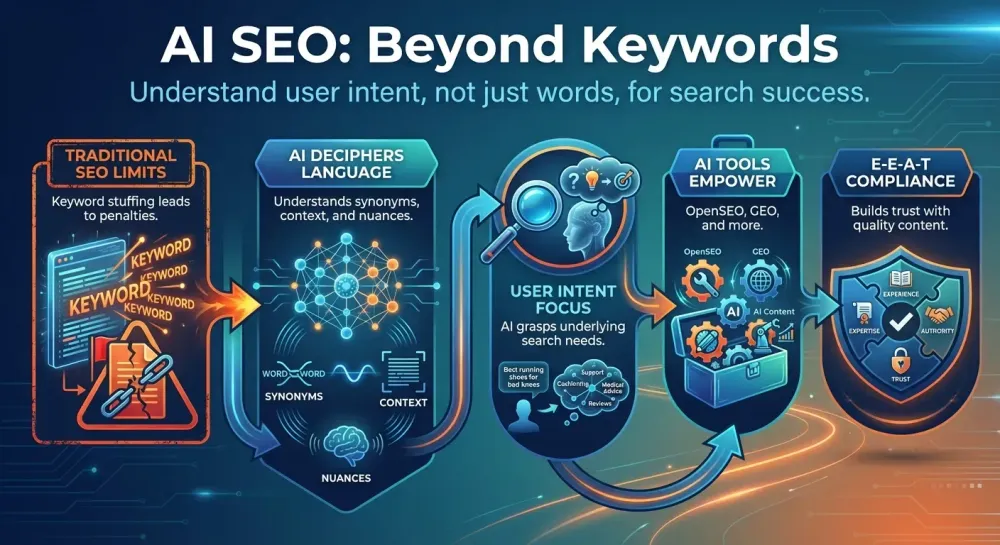
Initial AI applications in SEO were largely confined to generating content at scale. While this offered a speed advantage, the output often suffered from a lack of strategic insight. These tools could produce text, but they struggled with keyword integration, user intent analysis, and technical SEO considerations. The focus was on quantity rather than quality and strategic alignment, leading to content that might be keyword-stuffed or fail to resonate with search engine algorithms or user needs.
The Rise of Specialized AI SEO Tools
The current evolution sees a proliferation of specialized AI SEO tools, each honing in on critical aspects of SEO. Platforms like Semrush, Surfer SEO, and SE Ranking are no longer just content generators; they are becoming comprehensive suites. This includes advanced tools for intelligent keyword research, identifying high-potential long-tail keywords with low competition, and sophisticated content optimization. Furthermore, AI is being integrated into technical SEO audits and competitive analysis, offering a more holistic approach to improving search rankings.
Defining the 'Next Generation' of AI SEO
The 'next generation' of AI SEO is defined by a deeper understanding of search intent and user experience. Tools are moving beyond simple keyword matching to analyze the underlying reasons behind a search query. This includes anticipating emerging search paradigms like conversational search and AI-driven discovery. The shift is from mere 'writing assistance' to 'SEO strategy automation'. Platforms focusing on Generative Engine Optimization (GEO) and adhering to E-E-A-T (Experience, Expertise, Authoritativeness, Trustworthiness) standards exemplify this evolution, aiming to create content that is not only search-engine friendly but also inherently valuable and authoritative.
Key AI SEO Tool Categories Defining 2025
The landscape of AI SEO tools is rapidly evolving, with 2025 marking a significant shift towards more sophisticated and integrated solutions. Beyond basic keyword volume analysis, the focus is on understanding deeper user intent, enhancing content authority, automating complex technical tasks, and optimizing for the emerging era of generative AI search. This evolution is driven by the need for SEO strategies that are not only efficient but also deeply resonant with both search engines and users.
Advanced Keyword Intelligence and Intent Mapping
In 2025, leading AI SEO tools are moving beyond simple search volume metrics to provide profound insights into search intent and the user journey. These tools analyze query patterns, semantic relationships, and historical user behavior to map out comprehensive topic clusters and anticipate user needs at various stages of their decision-making process. This granular understanding allows for the creation of content that directly addresses user queries, fostering higher engagement and improved search rankings.
AI-Powered Content Optimization and E-E-A-T Enhancement
The emphasis for AI in content is shifting towards building topical authority and demonstrating E-E-A-T (Experience, Expertise, Authoritativeness, Trustworthiness). AI tools now analyze content not just for keyword density but also for its ability to showcase genuine experience, expert knowledge, and established authority. They assess user engagement potential by evaluating readability, depth of information, and the presence of authoritative signals, ensuring content meets the stringent quality standards of modern search algorithms.
Technical SEO Automation and Auditing
Technical SEO, often a complex and time-consuming aspect of optimization, is being revolutionized by AI. Tools are now capable of performing automated site audits, identifying crawl errors, broken links, and rendering issues with unparalleled speed and accuracy. Furthermore, AI is increasingly utilized for generating schema markup, which helps search engines better understand website content, leading to richer search results and improved visibility. This automation frees up SEO professionals to focus on strategic initiatives rather than manual checks.
Generative AI Optimization (GEO) for Emerging Search
A critical new frontier for AI SEO tools in 2025 is Generative AI Optimization (GEO). This category focuses on optimizing content for AI-driven search interfaces and conversational AI. Tools are being developed to structure content in ways that AI models can easily digest, synthesize, and present in direct answers or summaries. This includes optimizing for natural language queries and ensuring content is semantically rich enough to be leveraged by generative AI for more personalized and context-aware search experiences.
Spotlight on Innovation: Tools Shaping the Future
The landscape of Search Engine Optimization (SEO) is rapidly evolving, driven by advancements in artificial intelligence. This evolution is creating a new generation of AI SEO tools that promise to streamline workflows, uncover deeper insights, and empower marketers to achieve unprecedented growth. From comprehensive suites to specialized solutions, these tools are not just optimizing for search engines but are also preparing for the future of AI-driven search.
Integrated SEO Platforms: The All-in-One Approach
Leading platforms are at the forefront of this AI integration, moving beyond traditional data analysis to offer more predictive and actionable AI-driven insights. These all-in-one solutions are expanding their capabilities to cover content creation, technical SEO audits, and competitor research, all powered by sophisticated AI algorithms. This unified approach aims to simplify complex SEO strategies, allowing users to manage multiple facets of their online presence from a single dashboard.
Niche AI Tools for Specific SEO Challenges
Beyond broad platforms, specialized AI tools are emerging to tackle granular SEO challenges. These include AI-powered solutions for in-depth link building analysis, identifying high-value backlink opportunities, and performing detailed competitor intelligence to understand their strategies. Furthermore, AI is proving invaluable in content gap identification, pinpointing underserved topics and keywords that can be leveraged to create unique, high-ranking content.
The Role of AI in Local SEO and Voice Search
The impact of AI extends significantly to local SEO and the burgeoning field of voice search. AI is instrumental in optimizing for the local pack, understanding user intent for geographically specific queries, and personalizing search results. As voice search continues to grow, AI-driven tools are becoming essential for crafting content that naturally answers questions and is easily discoverable through spoken commands, ensuring businesses remain visible in this evolving search paradigm.
Emerging Trends: AI for SERP Feature Domination
A critical emerging trend is the use of AI to dominate SERP features. Tools are being developed to help content rank in high-visibility areas like featured snippets, People Also Ask boxes, and AI-generated summaries. Optimizing content for generative AI models ensures brands are discoverable in the future of AI-powered search. Furthermore, seamless platform integrations allow for automated content publishing, transforming how content is managed and scaled, making these tools powerful allies for driving SEO traffic growth.
User Experience, Integration, and Practical Application
The effectiveness of AI SEO tools hinges not just on their underlying technology, but on how seamlessly they integrate into existing workflows and how intuitively they are used. For professionals to truly leverage the power of AI in SEO, the user experience must be paramount.
The Importance of User-Friendly Interfaces
Tools need to be intuitive, even for non-technical SEOs. A complex interface can be a significant barrier to adoption, negating the benefits of advanced AI capabilities. Tools that simplify content creation and optimization ensure that users can access their powerful features without requiring extensive technical knowledge. This focus on usability allows a broader range of marketing professionals to benefit from AI-driven SEO insights.
Seamless Workflow Integration
The value of AI SEO tools is amplified when they connect with existing marketing stacks. Tools that integrate with platforms like WordPress reduce manual effort and streamline the content publishing process. This allows for greater efficiency, enabling users to push optimized content directly to their websites with features like automatic image setting, categorization, and tagging, thereby scaling content production significantly.
Practical Implication: Seamless integration means less time spent on manual data transfer and more time on strategy.
Actionable Tip: Prioritize AI SEO tools that offer direct integrations with your existing CMS (like WordPress) and analytics platforms (like Google Analytics) to automate data flow and reporting.
Measuring ROI and Performance Metrics
AI tools can provide clearer performance insights and justify investment. Data-driven optimization systems evaluate content on metrics like keyword density and readability, and provide actionable suggestions. This granular feedback helps users understand the impact of their content strategy and demonstrates a clear return on investment (ROI) by improving search engine rankings and traffic.
Ethical AI and Data Privacy Considerations
Addressing concerns around AI-generated content originality, bias, and data security is crucial. Users must be assured that the AI SEO tools they employ are not only effective but also responsible. This includes ensuring the originality of AI-generated content, mitigating potential biases within algorithms, and maintaining robust data privacy measures to protect user information and website integrity.
Preparing Your SEO Strategy for the AI-Dominated Future
The future of search is increasingly intertwined with artificial intelligence. To remain competitive, businesses must proactively adapt their SEO strategies to leverage AI's capabilities while understanding its limitations. This involves a nuanced approach to content creation, technical optimization, and strategic planning.
Adapting to AI-Driven Search Behavior
AI models are rapidly evolving in how they interpret and rank content. Understanding how AI algorithms process information, identify topical authority, and assess user intent is paramount. Ensuring generated content is aligned with what search engines favor, by adhering to E-E-A-T principles, is crucial.
The Human Element in AI-Assisted SEO
While AI can automate many tasks, human oversight, creativity, and strategic thinking remain indispensable. AI can generate content and identify keywords, but humans are crucial for crafting compelling narratives, ensuring brand voice consistency, and making informed decisions about overarching SEO strategy. This synergy between AI efficiency and human expertise is key.
Choosing the Right AI SEO Tools for Your Business
Selecting the appropriate AI SEO tools depends on specific business needs. Whether the focus is on in-depth keyword research, AI-driven content creation, technical SEO audits, or a combination, there are tailored solutions. An integrated approach, offering smart keyword research and AI-powered article generation with scoring, addresses a broad spectrum of these requirements.
Forecasting the Next Wave of AI SEO Innovations
Anticipating AI's role in personalized search, multimodal search (text, image, voice), and predictive SEO will be vital. AI's ability to understand context and user behavior will lead to hyper-personalized search results. Staying ahead means exploring how AI can predict user needs and deliver content proactively.
FAQ (Frequently Asked Questions)
Q1: How is AI SEO in 2025 different from what we saw with tools like ChatGPT?
A1: While ChatGPT excelled at content generation, 2025 AI SEO tools go far beyond this. They offer advanced keyword intelligence, intent mapping, E-E-A-T optimization, technical SEO automation, and are designed for Generative AI Optimization (GEO), focusing on strategic understanding and broader SEO functions rather than just text creation.
Q2: What is Generative AI Optimization (GEO) and why is it important for SEO in 2025?
A2: GEO is the practice of optimizing content specifically for AI-driven search interfaces and conversational AI. It involves structuring content so AI models can easily process, synthesize, and present it in direct answers or summaries, making it crucial for discoverability in the evolving AI search landscape.
Q3: Can AI SEO tools replace human SEO professionals entirely?
A3: No, AI SEO tools are designed to augment, not replace, human professionals. While they automate tasks, human creativity, strategic thinking, brand voice consistency, and ultimate decision-making remain indispensable for a successful SEO strategy.
Q4: How do AI SEO tools help in demonstrating E-E-A-T?
A4: AI tools analyze content for signals of Experience, Expertise, Authoritativeness, and Trustworthiness (E-E-A-T). They assess the depth of information, presence of authoritative sources, and the ability of content to showcase genuine knowledge, helping to align content with modern search engine quality standards.
Conclusion
The landscape of SEO is undergoing a profound transformation, moving far beyond rudimentary AI content generation. As we look towards 2025, the new generation of AI SEO tools is not just an evolution; it's a revolution. These sophisticated platforms are becoming increasingly specialized, seamlessly integrated, and remarkably intelligent, addressing every critical aspect of search engine optimization. From deciphering complex keyword intent and meticulously optimizing for E-E-A-T signals to automating intricate technical SEO tasks and proactively preparing for the seismic shift towards generative AI-driven search, these tools are unlocking unprecedented levels of performance for marketers.
The true power of these emerging AI SEO tools lies in their ability to empower businesses to not only navigate but to dominate the ever-evolving digital realm. Embracing this paradigm shift is imperative to thrive in 2025.
Actionable Recommendation: Begin by thoroughly researching and identifying the AI SEO tools that best align with your specific business objectives and current SEO challenges. Don't wait for the future to arrive; actively integrate these advanced capabilities into your strategy today.
Call to Action: Invest in the future of your online visibility by exploring and adopting the next wave of AI SEO innovation, and secure your competitive advantage in the dynamic world of online search.