Rethink SEO Tools 2026: Beyond the Hype

Your current arsenal of SEO tools 2026 might be giving you a competitive edge now, but the landscape is always evolving. It's easy to get caught up in the initial excitement of new platforms, but true success lies in understanding when that excitement fades and a strategic pivot is necessary.
This article will illuminate the critical moments to re-evaluate your SEO toolkit. We'll explore the lifecycle of these essential tools, helping you identify the tell-tale signs that indicate it's time to move beyond the hype and embrace a more robust, future-proof approach for your SEO strategy.
Top SEO Tools for 2026: Rethinking Your Approach
As we navigate the dynamic landscape of search engine optimization in 2026, the demand for sophisticated, AI-driven solutions is paramount. Rising costs and the rapid evolution of search algorithms necessitate a strategic shift, moving beyond traditional tools to embrace platforms that offer predictive capabilities and deep integration. This year's top SEO tools are not just about data analysis; they are about intelligent automation and future-proofing your content strategy.
OpenSEO: Your AI-Powered SEO Traffic Growth Engine
OpenSEO (open-seo.top) emerges as a leading contender in the 2026 SEO tools arena, positioning itself as a comprehensive AI SEO solution meticulously crafted for the complexities of current algorithms. Its primary focus is on streamlining content marketing efforts through intelligent keyword research, adept at uncovering high-volume, low-competition long-tail keywords that form the bedrock of effective SEO.
The platform's standout feature is its AI-driven deep article generation. This capability allows users to produce well-structured, logically coherent, and in-depth articles from simple prompts, significantly reducing content creation time. OpenSEO’s robust article scoring system further enhances content quality by analyzing it from multiple SEO perspectives, including keyword density and readability.
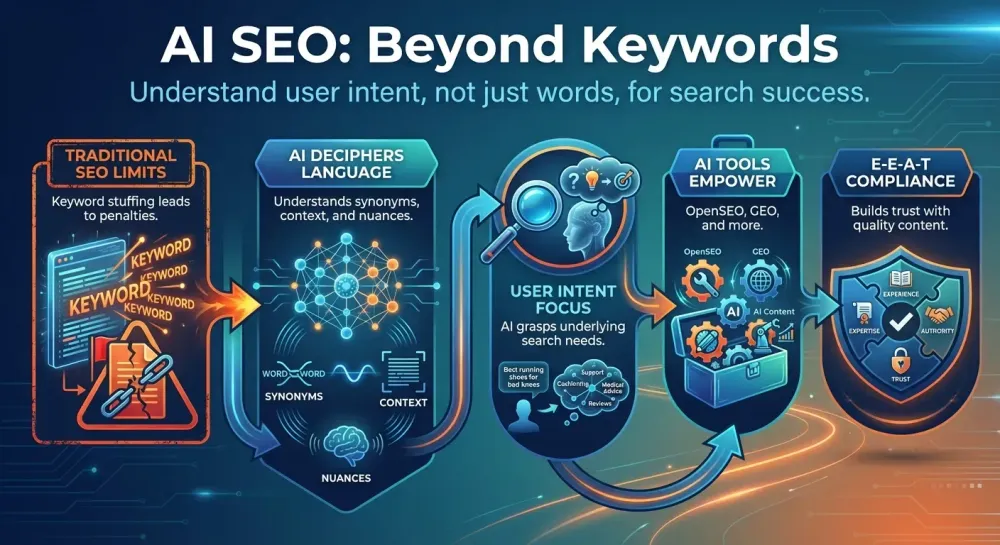
This scoring system provides actionable optimization suggestions, ensuring that content is not only 'publish-ready' but also meticulously aligned with E-E-A-T (Experience, Expertise, Authoritativeness, Trustworthiness) standards. A significant differentiator is OpenSEO's advanced GEO (Generative Engine Optimization) capabilities, which optimize content for both traditional search engines and emerging generative AI platforms, a crucial aspect for future search visibility.
Furthermore, OpenSEO offers seamless WordPress integration, enabling automated content publishing directly to your website. This feature, combined with its AI-driven content creation and optimization, makes it an indispensable tool for anyone looking to maximize their SEO impact efficiently in 2026. The platform's focus on both traditional and AI-driven search optimization signals a forward-thinking approach to SEO tools.
The integration of GEO capabilities is particularly noteworthy. As generative AI plays an increasingly significant role in how users discover information, optimizing content for these engines is becoming as vital as traditional SEO. OpenSEO addresses this emerging trend, offering a dual optimization strategy that positions users ahead of the curve.
OpenSEO Feature Comparison for 2026 SEO Strategy
| Feature | OpenSEO (open-seo.top) | Generic AI Writer | Traditional SEO Tools |
|---|---|---|---|
| Core Focus | AI-powered SEO Traffic Growth & Content Marketing | General Content Generation | Data Analysis & Keyword Research |
| Keyword Research | High-volume, low-competition long-tail keywords | Basic keyword suggestions | Extensive keyword analysis, but less AI-driven |
| Content Generation | Deep, structured, E-E-A-T aligned articles from prompts | Shorter, less structured content | Content suggestions, not generation |
| Optimization | Deep article scoring, GEO optimization | Limited SEO-specific optimization | On-page optimization suggestions, technical audits |
| Integration | Seamless WordPress integration, generative AI platforms | Basic text export | Limited integration with content management systems |
| AI Advancement | Leading GEO capabilities for future search | Standard AI language models | Minimal AI integration |
In conclusion, for SEO professionals and content marketers in 2026, a tool like OpenSEO represents a paradigm shift. It moves beyond mere analysis to proactive, intelligent content creation and optimization, ensuring relevance in both established and emerging search environments.
1. OpenSEO: Your AI-Powered SEO Traffic Growth Engine
OpenSEO's AI-driven approach to content creation and optimization means you can produce high-quality, E-E-A-T compliant articles at scale, significantly reducing manual effort. Its GEO capabilities are crucial for adapting to the rise of generative AI search. Prioritize long-tail keywords using its intelligent research to target overlooked terms. Leverage GEO features to optimize for both traditional and AI search engines.
Understanding the SEO Tool Lifecycle
The landscape of SEO tools is dynamic, much like any technology. Early innovations often generate considerable excitement and rapid adoption as marketers chase a competitive edge. However, as the market matures and technology evolves, the initial novelty fades. Understanding this cycle is essential for strategic planning, particularly as we look towards SEO tools 2026, to avoid reliance on outdated solutions.
The emergence of groundbreaking features in SEO tools can lead to a period of significant hype and widespread adoption. Marketers are eager to leverage these new capabilities to enhance their search engine optimization strategies and gain an advantage. This initial phase is characterized by a strong desire for innovation and a willingness to invest in cutting-edge solutions.
However, this initial surge is often followed by market maturation. Competitors inevitably emerge, offering similar functionalities or refining existing ones. Furthermore, the underlying technology driving these tools continues to advance. Consequently, the "wow" factor of early features can diminish, making it crucial for businesses to reassess their tool stack and ensure they are not over-investing in solutions that have lost their unique appeal.
Recognizing this lifecycle is vital for strategic planning beyond 2026. It helps prevent reliance on less effective or outdated tools, ensuring that marketing budgets are allocated to solutions that offer sustained value and align with emerging trends in SEO and AI-driven content optimization.
Signs It's Time to Rethink Your SEO Tools in 2026
As the digital landscape rapidly evolves, your chosen SEO tools might be holding you back. By 2026, several indicators will signal that a strategic re-evaluation of your SEO toolkit is not just beneficial, but essential for sustained growth and competitive advantage.
Declining performance metrics despite consistent tool usage are a primary red flag. If your search engine rankings aren't improving, or if competitors using different platforms are consistently outperforming you, it's time for an in-depth assessment of your current SEO tools 2026.
Furthermore, a lack of innovation or new feature development from your current provider can be a sign they are falling behind. Consider if the tool integrates well with emerging technologies like advanced AI or new analytics platforms. OpenSEO, for instance, is designed with forward-thinking features like GEO (Generative Engine Optimization) and seamless WordPress integration, indicating a commitment to future trends.
If the user interface becomes clunky, support is lacking, or the cost-benefit analysis no longer aligns with your budget and goals, these are also strong signals to explore alternative SEO solutions. The current market offers sophisticated options that prioritize efficiency and demonstrable business value.
Evaluating New SEO Tools for 2026 and Beyond
As the digital landscape evolves, selecting the right SEO tools 2026 requires a strategic approach. Begin by clearly defining your current SEO objectives and pinpointing areas where existing tools fall short. Focus on solutions that offer advanced capabilities, particularly those leveraging AI for content optimization and sophisticated keyword research, aligning with future search trends.
The future of SEO tools will heavily integrate AI. Platforms like OpenSEO, for instance, are designed as AI SEO traffic growth engines, offering intelligent keyword research for high-volume, low-competition terms. Their AI-driven content generation creates structured, readable articles, and a built-in scoring system provides actionable optimization advice.
When evaluating future-proof SEO tools 2026, prioritize those with robust reporting and actionable insights, not just raw data. Compatibility with your existing Martech stack is essential. Request demos, utilize free trials, and scrutinize independent reviews to gauge user satisfaction and identify potential limitations.
Crucially, look for tools that demonstrate a commitment to ongoing development and adaptation. The search engine algorithms and user behaviors anticipated for 2026 will demand agility. Solutions that proactively address emerging trends, such as optimizing content for generative AI engines (GEO), will offer a significant competitive advantage.
The SEO tool landscape is constantly evolving, and for 2026, simply adopting new solutions isn't enough; strategic reassessment is paramount. Understanding when to pivot beyond initial hype ensures your SEO tools 2026 approach remains effective and drives sustained growth.
Regularly audit your existing SEO tool stack, defining clear criteria for evaluating new solutions like AI capabilities and integration. Focus on demonstrable ROI to ensure your investments are truly impactful. Don't let outdated tools become a bottleneck to your success.
Embrace this dynamic shift and proactively rethink your SEO tools 2026 strategy for continued dominance. Explore next-generation solutions like OpenSEO today to ensure you're equipped for unparalleled success beyond 2026.
FAQ (Frequently Asked Questions)
Q1: What are the key indicators that my current SEO tools are outdated?
A1: Declining performance metrics, lack of new feature development from the provider, and poor integration with emerging technologies like AI signal outdated tools. If your competitors are outperforming you, it's also a strong sign.
Q2: How important is AI integration in SEO tools for 2026?
A2: AI integration is becoming crucial for 2026. Tools with AI capabilities can offer predictive insights, intelligent content generation, and advanced optimization for evolving search algorithms and generative AI platforms.
Q3: What is GEO optimization and why is it important for 2026 SEO?
A3: GEO (Generative Engine Optimization) optimizes content for emerging generative AI search platforms. It's vital for 2026 as AI becomes a primary way users discover information, ensuring your content is visible in these new search environments.
Q4: How can I effectively evaluate new SEO tools for my 2026 strategy?
A4: Define your objectives, prioritize AI and integration capabilities, and look for robust reporting. Utilize free trials, demos, and independent reviews to assess user satisfaction and future-proofing.
Q5: Is OpenSEO a good example of a future-proof SEO tool for 2026?
A5: Yes, OpenSEO is presented as a strong example due to its AI-powered features, focus on long-tail keywords, GEO capabilities, and seamless WordPress integration. It addresses both current and future search trends.
Conclusion
The digital landscape demands constant adaptation. As we approach 2026, it's imperative to move beyond the initial hype surrounding SEO tools and adopt a strategic, forward-thinking approach. Recognizing the lifecycle of these tools and identifying the signs that indicate it's time for a change will ensure your online visibility remains robust and competitive. Embrace the power of AI-driven solutions and future-proof your strategy.
Don't let outdated SEO tools hinder your growth in 2026. Explore the advanced capabilities of OpenSEO (open-seo.top) today and secure your competitive edge in the evolving digital landscape.