SEO: Why Deeper Context Matters for Search Success

Search engines are sophisticated arbiters of information, prioritizing websites that demonstrate a profound grasp of user intent. They favor content that is truly authoritative and experience-rich, and they navigate the evolving influence of generative AI. This article will guide you through why this deeper contextual understanding isn't just a trend, but the absolute cornerstone of modern SEO success. It ensures your digital presence resonates meaningfully with your target audience and outshines the competition.
The Shifting Sands of Search: Why Context is King in Modern SEO
The landscape of online search is in constant flux, moving beyond simple keyword matching to a more nuanced understanding of user intent. This evolution, coupled with the rise of generative AI, makes context the undisputed king in modern SEO. Gone are the days when stuffing exact keywords was sufficient. Today, search engines prioritize content that deeply addresses the underlying 'why' behind a user's search.
From Keywords to Conversations: The Evolution of Search Intent
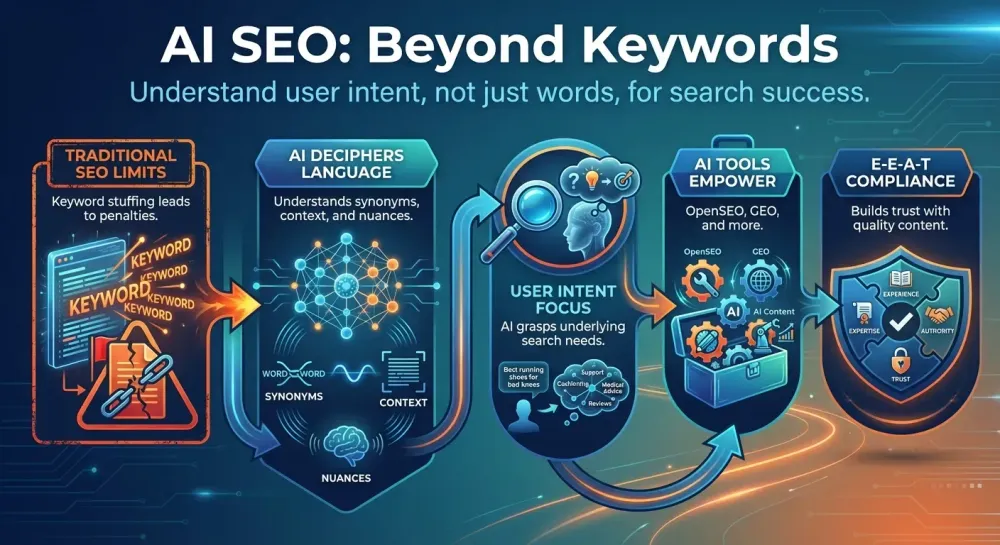
Historically, SEO focused heavily on exact keyword matching. However, search engines have become sophisticated enough to understand synonyms, related concepts, and the broader intent behind a query. This means that merely optimizing for a single keyword is no longer effective. Instead, content must be crafted to answer the full spectrum of questions a user might have. This transforms static pages into dynamic resources that engage in a "conversation" with the searcher.
Beyond the Surface: Understanding User Needs and Pain Points
To truly excel in modern SEO, a deep dive into user needs and pain points is essential. Search engines increasingly reward content that demonstrates E-E-A-T: Experience, Expertise, Authoritativeness, and Trustworthiness. This is achieved by genuinely solving user problems. Tools like OpenSEO, which offers intelligent keyword research and AI-driven content generation with SEO scoring, can assist in uncovering these needs and crafting content that resonates. The goal is to provide comprehensive answers that satisfy the user's quest for information.
The Rise of Generative AI and its Impact on Search
Generative AI models are fundamentally changing how users interact with search. Instead of sifting through multiple links, users are increasingly turning to AI for direct answers. This necessitates content that is not only informative but also structured and semantically rich to be easily understood and leveraged by these AI systems. Platforms like OpenSEO are adapting by incorporating Generative Engine Optimization (GEO) to ensure content is discoverable within these new AI-driven search paradigms, demanding more nuanced and context-aware SEO strategies.
Decoding User Intent: The Cornerstone of Contextual SEO
Understanding what a user truly wants is paramount in modern SEO. Moving beyond basic keyword categories, effective contextual SEO delves into the user's journey. It recognizes that a single query can represent multiple underlying intents. Tools and analytics are crucial for inferring these user goals and motivations, allowing us to map content precisely to specific stages of their decision-making process. This nuanced approach ensures our content resonates deeply, driving not just traffic, but meaningful engagement.
Navigational, Informational, Transactional, and Commercial: A Deeper Dive
These four core intent categories form the bedrock of user understanding. Informational intent, for example, is when a user seeks knowledge, like "how to improve website ranking." Navigational intent is about finding a specific site, such as "OpenSEO login." Commercial intent precedes a purchase, with users researching options like "best AI SEO tools." Finally, Transactional intent signifies a user ready to act, e.g., "buy OpenSEO subscription." Recognizing these distinctions allows for tailored content creation, ensuring users find exactly what they need at each stage.
Identifying Implicit vs. Explicit Intent
While explicit intent is clear from keywords (e.g., "buy SEO software"), implicit intent is subtler. A search for "SEO content generation tools" might imply a need for efficiency and cost-effectiveness, even if not directly stated. Tools like OpenSEO, with its focus on AI-driven content creation and SEO scoring, excel at addressing both. By analyzing search patterns and user behavior, we can infer these hidden motivations and craft content that preempts user needs, a key differentiator in competitive SEO landscapes.
Leveraging Data for Intent Analysis
Data is the compass for intent analysis. Analytics platforms reveal how users interact with content, which pages they visit, and how long they stay. This information helps us understand if our content is meeting informational, navigational, commercial, or transactional needs. Tools like OpenSEO provide SEO scoring and keyword research capabilities that directly inform content strategy, ensuring it aligns with high-potential, user-centric search queries. By continuously analyzing this data, we can refine our SEO efforts, making them more precise and impactful.
Content Depth and Authority: Building Trust in a Noisy Digital Landscape
In today's crowded digital sphere, establishing trust is paramount for effective SEO. Google's algorithms increasingly prioritize content that demonstrates genuine value and credibility. This is where the concept of content depth and authority becomes critical for any successful SEO strategy.
The E-E-A-T Framework: Expertise, Experience, Authoritativeness, and Trustworthiness
Google's E-E-A-T framework (Experience, Expertise, Authoritativeness, Trustworthiness) serves as a cornerstone for identifying high-quality content. To build trust, your content must showcase real-world experience and deep expertise in your niche. This means going beyond surface-level information to provide insights derived from practical application. For example, a financial advisor's blog should feature case studies of client success, not just general advice. Demonstrating authoritativeness is achieved through credible backlinks and mentions from reputable sources, while trustworthiness is built through transparent practices and positive user reviews.
Creating Comprehensive and Authoritative Content
The value of in-depth content cannot be overstated. Comprehensive articles that thoroughly cover a topic, answering all potential user questions, are favored by both search engines and users. Tools like OpenSEO can assist in generating structured, detailed content. For instance, a guide on "advanced SEO techniques" should not only define terms but also explain their practical implementation and potential impact, supported by data and examples. This level of detail establishes your site as a go-to resource.
The Role of Original Research and Unique Perspectives
Original research and unique perspectives are powerful differentiators. When content offers novel insights or data not readily available elsewhere, it naturally gains authority. This could involve conducting your own surveys, analyzing unique datasets, or sharing firsthand experiences. Such content is more likely to be cited and linked to by others, significantly boosting your SEO efforts and reinforcing your standing as a trustworthy expert in your field.
Generative AI Optimization (GEO): Preparing for the Future of Search
The digital landscape is rapidly evolving with the advent of AI-powered search. Understanding and adapting to these changes is crucial for maintaining visibility and driving traffic. This section explores how to optimize content for the new era of Generative AI Optimization (GEO).
Understanding Generative AI Search Interfaces
The emergence of AI-powered search summaries and conversational interfaces signifies a paradigm shift. Instead of just a list of links, users are increasingly interacting with synthesized answers directly within search results. This necessitates a content strategy that caters to both traditional search engines and these new AI comprehension models.
Structuring Content for AI Comprehension
To ensure content is easily understood and synthesized by AI, a clear, logical structure is paramount. This involves employing semantic relevance and entity recognition. Well-organized content with distinct headings, bullet points, and concise paragraphs allows AI to more accurately extract key information and understand the relationships between concepts.
Semantic Relevance and Entity Recognition
The importance of clear, logical structure and semantic connections cannot be overstated. Tools like OpenSEO are pioneering strategies for GEO, focusing on making content discoverable by both traditional search engines and emerging AI. By emphasizing factual accuracy, clear attribution, and a deep understanding of subject matter, content becomes more robust and reliable for AI summarization and response generation. This proactive approach ensures your SEO efforts are future-proofed.
Practical Application: Tools and Strategies for Deeper Contextual SEO
Achieving deeper contextual relevance in SEO requires moving beyond basic keyword analysis to embrace advanced tools and integrated workflows. This section explores how to leverage cutting-edge solutions for more effective content creation and optimization.
Leveraging Advanced Keyword Research for Context
Effective SEO begins with understanding user intent. Instead of just basic keyword tools, focus on identifying long-tail, intent-rich queries. This involves delving into niche topics and understanding the specific questions users are asking. Platforms like OpenSEO excel here, offering intelligent keyword research that uncovers high-potential, low-competition phrases, ensuring your content directly addresses user needs and improves SEO.
AI-Powered Content Creation for Depth and Relevance
AI assistants are revolutionizing content creation by generating comprehensive outlines and drafts, ensuring logical flow and depth. OpenSEO's AI deep article generation transforms simple themes or keywords into structured, rich content. It automatically incorporates elements like H-tags and bolded key phrases, significantly enhancing readability and AI comprehension. Furthermore, its article scoring system provides data-driven feedback on keyword density, readability, and content depth, guiding optimization for maximum SEO impact.
Streamlining Content Workflows with Integrated Solutions
Efficient content deployment is crucial for SEO success. Solutions like OpenSEO offer integrated workflows that streamline the entire content lifecycle. By combining intelligent keyword research, AI-driven content generation, and article scoring within a single platform, users can produce high-quality, relevant content more effectively. This integrated approach ensures that content is not only optimized for search engines but also resonates with the target audience.
The Power of WordPress Integration for Seamless Publishing
Seamless integration with Content Management Systems (CMS) like WordPress is a significant advantage. OpenSEO's seamless WordPress integration allows for one-click publishing, automating tasks like setting featured images, categories, and tags. This dramatically speeds up content deployment and management, enabling a more consistent and scalable SEO strategy. Focusing on readability and structure, as facilitated by these tools, is paramount for both user experience and search engine understanding.
Measuring Success in a Contextual SEO Landscape
In today's dynamic digital environment, effective SEO transcends mere keyword rankings. The focus has decisively shifted towards understanding and satisfying user intent, ultimately driving tangible business outcomes. Tools like OpenSEO, designed to optimize content for both search engines and generative AI, highlight this evolution by emphasizing data-driven content creation.
Beyond Rankings: Metrics That Matter
While keyword positions offer a glimpse, true success in SEO is measured by user satisfaction and business impact. Instead of solely tracking rankings, we must analyze metrics such as dwell time, bounce rate, and, crucially, conversion rates. These indicators reveal how well content resonates with the target audience and contributes to business goals.
User Engagement and Conversion as Key Indicators
High dwell times and low bounce rates suggest users find your content valuable and engaging, a direct outcome of contextual relevance. OpenSEO's AI-driven article generation and scoring system aids in creating content that not only appeals to search algorithms but also captivates users, leading to higher engagement and ultimately, conversions.
The Long-Term Value of Contextual Relevance
Contextual relevance builds lasting organic traffic and fosters customer loyalty. By consistently providing high-quality, pertinent information, websites establish authority and trust. This continuous SEO effort, requiring ongoing adaptation to algorithm changes and user behavior, ensures sustained growth and a strong online presence.
FAQ (Frequently Asked Questions)
Q1: What is the primary shift in SEO tactics today?
A1: The primary shift in SEO today is from a focus on keyword stuffing and basic link building to a deeper contextual understanding of user intent, aiming to provide comprehensive, authoritative, and experience-rich content that satisfies user needs.
Q2: How does generative AI impact SEO strategies?
A2: Generative AI is changing search by providing direct answers, meaning content needs to be structured and semantically rich for AI comprehension. This leads to Generative Engine Optimization (GEO), focusing on content that AI can easily understand and synthesize.
Q3: What does E-E-A-T stand for and why is it important for SEO?
A3: E-E-A-T stands for Experience, Expertise, Authoritativeness, and Trustworthiness. It's crucial for SEO because search engines increasingly reward content that demonstrates these qualities, indicating high-quality, reliable information that users can trust.
Q4: How can tools like OpenSEO help with modern SEO?
A4: Tools like OpenSEO aid in modern SEO by offering intelligent keyword research to uncover user intent, AI-powered content generation to create in-depth and relevant articles, and article scoring to provide data-driven feedback for optimization, ensuring content meets both user and search engine requirements.
Conclusion
In essence, the landscape of SEO has irrevocably shifted. Gone are the days of keyword stuffing and shallow optimizations; the future, and indeed the present, belongs to those who master a deeper contextual understanding. By truly grasping user intent, cultivating authentic authority, and adapting to the evolving intelligence of AI-powered search, businesses can forge content that not only captivates audiences but also speaks the language of search engines. This necessitates a proactive approach, moving beyond surface-level tactics to embrace a holistic strategy.
Therefore, to not just survive but thrive in this dynamic digital ecosystem, it is imperative to invest in this nuanced form of SEO. Consider leveraging advanced tools and platforms, like OpenSEO, that are specifically designed to illuminate these deeper contextual layers, providing you with the strategic edge needed to navigate modern complexities. The actionable recommendation is clear: prioritize building genuine value and comprehensive understanding in your content creation. Don't just chase rankings; aim to be the definitive, authoritative answer to user queries. Embrace contextual SEO today and unlock the door to sustainable organic growth, enduring user satisfaction, and long-term digital relevance. Your audience, and the search engines, will thank you for it.