What is SEO? Beginner's Guide to Search Engine Optimization

Image source: Pexels
In today's crowded digital marketplace, simply having a website isn't enough; you need to be found. Imagine your online presence as a storefront on a busy street – if no one can see it, how will potential customers discover you? This is precisely where the magic of Search Engine Optimization (SEO) comes into play. If you've ever wondered what is SEO and how it can transform your online visibility, you've come to the right place.
This beginner-friendly guide will pull back the curtain on this essential digital marketing practice. We'll break down the core concepts, explain why mastering SEO is no longer optional but a necessity for success, and equip you with the foundational knowledge to start attracting valuable organic traffic. Get ready to unlock the secrets of making your website shine in search results and achieve your online aspirations.
What Exactly is SEO? Decoding Search Engine Optimization
Search Engine Optimization (SEO) is the fundamental practice of enhancing a website's visibility and discoverability within search engine results pages (SERPs). In essence, it's the ongoing process of making your website more appealing to search engines like Google, thereby increasing the likelihood that users will find your content when they search for relevant information.
The Core Concept: Making Your Website Discoverable
At its heart, SEO is about bridging the gap between what users are searching for and the content you provide. Search engines employ complex algorithms to understand and categorize web pages. By optimizing your website, you help these algorithms understand your content's relevance and value, leading to higher rankings. This process is crucial for any online entity aiming to attract organic traffic.
SEO vs. Paid Advertising: The Organic Advantage
It's important to distinguish SEO from paid advertising. While paid ads appear at the top of search results and require direct payment, SEO focuses on earning organic rankings. This means achieving visibility through merit and relevance, rather than budget. The "organic advantage" lies in the long-term trust and credibility built with users when their search queries are met by genuinely valuable content.
Why 'Optimizing' Matters: The Search Engine's Perspective
Search engines are driven by a singular goal: to provide users with the most relevant and helpful results. When you "optimize" your website, you are essentially aligning your content with the search engine's criteria. This involves understanding user search intent and incorporating relevant keywords naturally, ensuring your pages are technically sound, and offering a positive user experience.
The Ultimate Goal: Connecting Users with Relevant Content
Ultimately, the success of SEO hinges on connecting users with the content they are looking for. This user-centric approach means creating high-quality, informative, and engaging material that directly addresses search queries. By prioritizing relevance and value, SEO not only improves search engine rankings but also fosters a better experience for visitors, driving targeted traffic and building lasting engagement.
The Pillars of SEO: On-Page, Off-Page, and Technical Foundations
Understanding what is SEO is crucial for any online presence. A robust SEO strategy isn't a single tactic but a holistic approach built upon three interconnected pillars: On-Page, Off-Page, and Technical SEO. Neglecting any one of these can significantly hinder your website's potential.
On-Page SEO: Optimizing Your Content and HTML
On-page SEO focuses on optimizing elements directly on your website. This includes strategic keyword integration within compelling titles and meta descriptions, ensuring your content is relevant and engaging for users. Creating high-quality content that addresses user intent is paramount. Furthermore, internal linking helps distribute authority across your site, while image optimization (using descriptive alt text) improves accessibility and search engine understanding.
Off-Page SEO: Building Authority and Trust
Off-page SEO involves actions taken outside your website to impact your rankings. The most significant factor here is backlinks, where the quality over quantity of links pointing to your site is key. Earning links from reputable sources signals trust and authority to search engines. Other off-page signals include brand mentions, which increase brand awareness, and social signals, indicating content popularity. For businesses with a physical presence, local SEO efforts are vital for attracting nearby customers.
Technical SEO: Ensuring Your Website is Search Engine Friendly
Technical SEO is the backbone that allows search engines to crawl, index, and understand your website effectively. This involves optimizing website speed for a better user experience, ensuring mobile-friendliness as most searches occur on mobile devices, and establishing a clear site architecture. Crucial for discoverability are crawlability and indexability, managed through elements like sitemaps and the robots.txt file. A technically sound website ensures that all your on-page and off-page efforts are not in vain.
The Interplay: How These Pillars Work Together
These three pillars are not independent; they work in synergy. High-quality, keyword-optimized content (On-Page) is more likely to earn backlinks (Off-Page) and be easily discoverable by search engines on a well-structured, fast website (Technical). A strong SEO strategy, therefore, requires a holistic approach, leveraging techniques across all three foundations to achieve maximum visibility and drive targeted traffic.
The Power of Keywords: Your Gateway to Search Traffic
Understanding what is SEO begins with recognizing the pivotal role of keywords. Keywords are the bridge between what users are searching for and the content you provide. They are the foundation of attracting targeted traffic to your website from search engines' organic rankings.
Understanding Keyword Intent: What Are Users Really Looking For?
Keyword intent is the underlying reason or goal behind a user's search query. It's crucial because it dictates the type of content that will satisfy their needs. For instance, someone searching "how to bake a cake" has informational intent, seeking instructions, while "buy chocolate cake online" indicates transactional intent, aiming to make a purchase. Aligning your content with this intent is paramount for effective SEO.
Types of Keywords: Navigational, Informational, Transactional, and Commercial
Keywords can be broadly categorized by user intent:
Long-Tail Keywords: The Untapped Goldmine
Long-tail keywords are longer, more specific phrases (e.g., "AI tool for generating SEO-optimized blog posts"). While they typically have lower search volume individually, they often boast lower competition and significantly higher conversion rates because they capture users with very specific needs. Targeting these phrases can unlock a significant portion of untapped search traffic.
Keyword Research Tools and Strategies
Effective keyword research is the bedrock of any successful SEO strategy. Tools are essential for identifying high-volume, low-competition keywords relevant to your audience. Popular tools include Google Keyword Planner, Ahrefs, SEMrush, and Moz Keyword Explorer, each offering unique insights into search volume, keyword difficulty, and related terms. The strategy involves brainstorming seed keywords, using tools to expand on them, analyzing competitor keywords, and understanding user search patterns.
Integrating Keywords Naturally into Your Content
Once keywords are identified, their integration into your content must be seamless. Avoid "keyword stuffing," which is the excessive repetition of keywords, as it harms readability and search engine rankings. Instead, focus on incorporating keywords naturally within headings, body text, and meta descriptions, ensuring your content remains valuable and user-friendly. Think about how you would naturally explain your topic to a friend; that's the approach to take.
Content is King (and Queen!): Crafting Search-Engine-Savvy Content
Understanding what is SEO fundamentally boils down to creating content that both users and search engines love. High-quality content is the bedrock of effective SEO, serving as the primary vehicle for attracting and engaging your target audience.
What Makes Content 'High-Quality' for SEO?
Truly high-quality content is more than just words on a page. It is original, informative, engaging, and demonstrably meets user needs. This means going beyond superficial explanations to provide in-depth insights, actionable advice, and unique perspectives. It should answer the questions users are asking, solve their problems, and leave them feeling satisfied and informed. This type of content is what search engines aim to surface to their users.
The Role of E-E-A-T: Experience, Expertise, Authoritativeness, and Trustworthiness
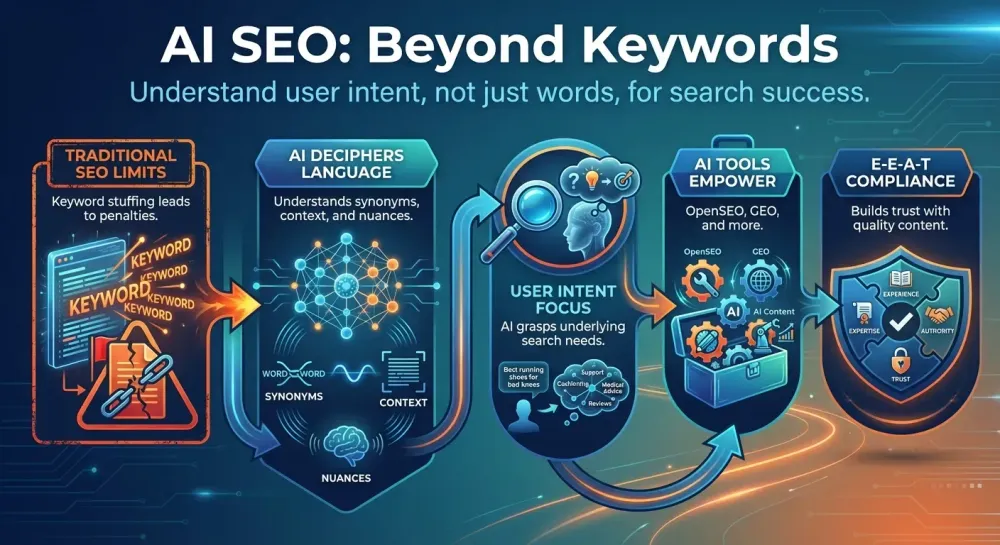
Google's E-E-A-T guidelines are paramount for ranking. This framework emphasizes that content should be created by individuals or entities demonstrating Experience (first-hand knowledge), Expertise (deep understanding), Authoritativeness (recognized as a go-to source), and Trustworthiness (reliable and safe). For content to rank well and build user confidence, it must clearly signal these qualities. This can be achieved through author bios, citing credible sources, showcasing testimonials, and providing clear contact information.
Structuring Your Content for Readability and Search Engines
Effective content structure is crucial for both user experience and search engine crawling. This involves using clear headings (H1 for the main title, H2s and H3s for subtopics), bullet points for scannability, short paragraphs for easier digestion, and straightforward language. This organization helps users find information quickly and allows search engines to better understand the content's hierarchy and key themes. Well-structured content improves user engagement and reduces bounce rates, both of which are positive SEO signals.
The Rise of AI in Content Creation: Opportunities and Considerations
Artificial intelligence is rapidly transforming content creation, offering tools that can generate outlines, draft sections, and even suggest keywords. However, it's crucial to remember that AI is a tool, not a replacement for human creativity and critical thinking. Human oversight, fact-checking, and adding unique insights remain vital to ensure content is truly valuable, accurate, and meets E-E-A-T standards. AI-generated content without human refinement can often be generic and lack the depth required for high rankings.
Measuring Content Performance and Iterating
The final, crucial step in the SEO content lifecycle is measurement. Utilizing analytics tools like Google Analytics to track metrics such as organic traffic, user engagement (time on page, bounce rate), conversion rates, and keyword rankings provides invaluable insights into what is SEO working for your content and what needs improvement. This data-driven approach allows for continuous iteration and refinement, ensuring your content remains relevant, engaging, and effective in achieving your search engine optimization goals. Regularly reviewing performance data is key to adapting your content strategy.
Beyond the Basics: Emerging Trends and Future-Proofing Your SEO
As the digital landscape evolves at an unprecedented pace, understanding what is SEO goes beyond traditional keyword research and on-page optimization. Staying ahead means embracing new search modalities and evolving user behaviors.
The Evolution of Search: Voice Search, Visual Search, and AI-Powered Search
Search is no longer confined to typing keywords into a desktop browser. Voice search, driven by smart speakers and mobile assistants, favors natural, conversational language. Visual search, powered by image recognition, allows users to search using images. Furthermore, AI-powered search is becoming more sophisticated, with generative AI models capable of synthesizing information and providing direct answers. Your keyword strategies must adapt to these shifts, incorporating more question-based and conversational queries.
The Importance of User Experience (UX) in SEO
Search engines increasingly prioritize user satisfaction as a key ranking factor. Signals like bounce rate (the percentage of visitors who leave after viewing only one page) and time on page (how long a user spends on your content) directly influence rankings. A positive user experience, characterized by easy navigation, fast loading times, and engaging, relevant content, is therefore paramount for SEO success. Investing in a user-friendly website design is an investment in your search engine visibility.
Local SEO: Connecting with Your Local Audience
For businesses that serve a specific geographic area, local SEO strategies are crucial for visibility in local search results and map packs. This involves optimizing your Google Business Profile, ensuring consistent NAP (Name, Address, Phone number) information across online directories, and encouraging local customer reviews. Local SEO helps you attract nearby customers who are actively searching for your products or services.
The Future of SEO: Generative AI Optimization (GEO)
The future of SEO is rapidly evolving to include optimization for generative AI platforms. This means creating content that AI can easily understand, process, and synthesize into comprehensive answers for users. This is often referred to as Generative AI Optimization (GEO).
Actionable Tips for GEO:
1. Focus on structured data: Use schema markup (e.g., JSON-LD) to help AI understand the context, relationships, and entities within your content. This provides clear signals about what your content is about.
2. Prioritize clarity and conciseness: Generative AI often favors direct, well-explained information that clearly answers specific questions. Break down complex topics into digestible sections.
3. Build authority and trust: AI models are trained on vast datasets and tend to favor information from authoritative and trustworthy sources. Demonstrating E-E-A-T is more critical than ever.
4. Create comprehensive content: While conciseness is key, AI also values content that thoroughly covers a topic, providing depth and multiple perspectives.
Staying Ahead: Continuous Learning and Adaptation
SEO is not a set-it-and-forget-it discipline; it's an ongoing process of learning, testing, and adaptation. Search engine algorithms are constantly updated, and new technologies emerge regularly. Continuous learning and adaptation to these changes are essential for sustained success. Stay informed by following reputable SEO blogs, attending webinars, and experimenting with new strategies.
FAQ (Frequently Asked Questions)
Q1: What is the difference between SEO and SEM?
A1: SEO (Search Engine Optimization) focuses on earning organic, unpaid traffic by improving your website's visibility in search engine results. SEM (Search Engine Marketing) is a broader term that encompasses both SEO and paid advertising (like Google Ads), aiming to increase visibility in search results through both organic and paid methods.
Q2: How long does it take to see results from SEO?
A2: SEO is a long-term strategy. It can take anywhere from a few weeks to several months (3-6 months or even longer) to see significant results, depending on factors like competition, website authority, and the effectiveness of your strategy. Consistent effort and patience are key.
Q3: What are the most important factors for Google rankings?
A3: While Google's algorithm is complex and constantly evolving, some of the most consistently important factors include: high-quality, relevant content; strong backlinks from reputable sources; good user experience (UX), including mobile-friendliness and site speed; and technical SEO that ensures your site is easily crawlable and indexable.
Q4: Do I need to hire an SEO expert to succeed?
A4: While you can learn and implement basic SEO yourself, an experienced SEO expert or agency can significantly accelerate your results and navigate the complexities of algorithm updates and advanced strategies. However, understanding the fundamentals, as outlined in this guide, is crucial even when working with professionals.
Conclusion
In essence, grasping what is SEO isn't just about understanding a technical discipline; it's about unlocking the gateway to your website's true potential and ensuring it thrives in the competitive digital landscape. We've explored how the foundational pillars of SEO – crafting exceptional, user-focused content that genuinely answers search queries, meticulously optimizing your website's technical infrastructure for seamless crawling and indexing, and diligently building your site's authority through credible backlinks and positive user signals – are the cornerstones of achieving higher search engine rankings and drawing in a consistent stream of valuable organic traffic.
While the digital realm is in perpetual motion, the enduring principles of delivering tangible value and absolute relevance to your audience remain the unwavering compass for success. Don't let the perceived complexity deter you; embrace the continuous learning and iterative process that SEO entails. Start by implementing the actionable recommendations we've discussed: audit your current content, identify technical improvements, and begin strategizing your link-building efforts. The journey of SEO is an investment, and with dedication and the right strategic approach, you can confidently navigate the intricacies of search engines, establish a strong online presence, and forge meaningful connections with your ideal customers like never before. Begin your SEO journey today and watch your online visibility soar!