12 min read3 viewsAuthorOpenSEO Team

What is SEO for Beginners? Your 2025 Guide

What is SEO for Beginners? Your 2025 Guide

For beginners, the world of SEO can feel like an intricate puzzle. Fear not! This comprehensive guide is designed to demystify SEO, breaking down its fundamental concepts and unveiling actionable strategies. We’ll explore how the cutting edge of AI is revolutionizing SEO, making it more intuitive and powerful than ever before, and even touch upon how innovative tools can help you craft content that not only climbs search rankings but truly captivates your audience.

1. What Exactly is SEO? Unpacking the Acronym

SEO stands for Search Engine Optimization. It's the dedicated practice of enhancing a website's presence and visibility within search engine results pages (SERPs). The primary aim is to drive organic, or unpaid, traffic to your website, making it easier for potential users to discover your content, products, or services.

Why Search Engines Matter Today

Search engines like Google and Bing are indispensable gateways for users seeking information, products, and services online. In today's digital landscape, a strong search engine presence is crucial for any entity aiming to connect with its target audience. Effective SEO helps these search engines understand precisely what your content is about and, critically, match it with relevant user queries.

The Core Goal: Connecting Users with Relevant Content

The fundamental objective of SEO is to bridge the gap between users and the information they are actively seeking. By optimizing your website's content and technical aspects, you signal to search engines that your pages offer valuable, relevant answers to specific questions. This strategic alignment ensures that when a user performs a search, your website has a higher probability of appearing prominently, thus facilitating a connection with that interested individual.

2. The Pillars of SEO: How Search Engines 'See' Your Website

Understanding how search engines perceive your website is fundamental to effective SEO. It's about optimizing your website to rank higher on search engines like Google, making it easier for customers to find you. This process is built upon several key pillars that work in synergy to improve your site's visibility and authority.

On-Page SEO: Optimizing Your Content and HTML

On-page SEO involves optimizing elements directly on your web pages. This includes crafting compelling title tags and meta descriptions that accurately summarize your content and entice users to click. Utilizing headings (H1, H2, etc.) helps structure your content logically for both readers and search engine crawlers. Crucially, the quality of your content itself – its relevance, depth, and originality – is paramount.

Off-Page SEO: Building Authority and Trust

Off-page SEO focuses on external factors that signal your website's authority and trustworthiness to search engines. The most significant of these are backlinks from reputable and relevant websites, which act as votes of confidence. Social signals, such as shares and mentions on social media platforms, also contribute to your site's perceived credibility.

Technical SEO: Ensuring Your Site is Crawlable and Indexable

Technical SEO is the backbone of your website's search engine visibility. It ensures that search engines can easily crawl, understand, and index your website. This covers critical aspects like site speed, which directly impacts user experience and rankings, and mobile-friendliness, as a vast number of searches occur on mobile devices. Implementing sitemaps helps search engines discover all your important pages.

The Evolving Role of User Experience (UX) in SEO

In today's digital landscape, user experience (UX) is no longer a secondary consideration; it is increasingly crucial for SEO success. Search engines are designed to reward websites that provide a positive and engaging experience for visitors. This means ensuring your site is easy to navigate, loads quickly, and offers valuable content that keeps users on the page. A good UX reduces bounce rates and increases dwell time, sending positive signals to search engines about your site's quality and relevance.

3. Why SEO is Crucial for Beginners in 2025: The Competitive Edge

In 2025, navigating the digital landscape means understanding the fundamental principles of what is SEO and why it's no longer optional, but essential. For beginners, mastering SEO provides a critical competitive edge in an increasingly crowded online space. It's about ensuring your brand isn't just present, but discoverable.

The Ever-Increasing Digital Landscape

The online world is more saturated than ever. With millions of websites vying for attention, visibility is paramount. Without a strategic SEO approach, even the most valuable products or services can remain hidden. This is where understanding what is SEO becomes vital for any new venture aiming to make an impact.

The Power of Organic Traffic: Cost-Effective and Sustainable

Organic traffic, the unpaid visitors who find you through search engines, is gold. It's highly valuable because it's free, and these users tend to be more engaged, actively seeking solutions. Businesses that prioritize SEO build a sustainable flow of targeted visitors, reducing reliance on costly advertising.

Building Brand Authority and Trust

A strong SEO presence inherently builds credibility and trust. When your website consistently appears at the top of search results for relevant queries, it signals to potential customers that you are a reliable and authoritative source. This organic validation is invaluable for brand building.

Staying Ahead of the Competition

Businesses that neglect SEO in 2025 risk being outshone by competitors who are actively optimizing. SEO isn't a one-time task but an ongoing process of adaptation and improvement. For beginners, embracing SEO early means laying a solid foundation for growth and ensuring you don't fall behind from the outset.

4. Key SEO Strategies for Beginners in 2025: Actionable Steps

Embarking on your SEO journey in 2025 requires a strategic approach that blends foundational principles with the latest advancements. Understanding what is SEO and how to implement it effectively is crucial for any beginner aiming to boost their online visibility. This section outlines actionable steps to help you navigate the evolving landscape of search engine optimization.

Keyword Research: The Foundation of Your Content Strategy

The cornerstone of successful SEO is thorough keyword research. This process involves identifying the terms and phrases your target audience uses when searching for information, products, or services. Tools can be invaluable here, helping you uncover high-volume keywords with lower competition. By focusing on these "long-tail" keywords, you can attract more qualified traffic and establish your authority in niche areas.

Crafting High-Quality, User-Centric Content

Once you have your keywords, the next step is to create content that directly answers user questions and provides genuine value. High-quality content is comprehensive, well-researched, and easy to understand. Prioritize readability through clear formatting, engaging language, and a logical structure. Remember, search engines aim to serve users the best possible results, so your content must be engaging and informative.

Link building, the process of acquiring backlinks from other reputable websites, is a significant ranking factor. These backlinks act as "votes of confidence" for your site, signaling to search engines that your content is trustworthy and authoritative. To start, focus on creating exceptional content that others will naturally want to link to. Then, engage in outreach to relevant websites, offering guest posts or highlighting your valuable resources.

Leveraging AI for SEO Efficiency

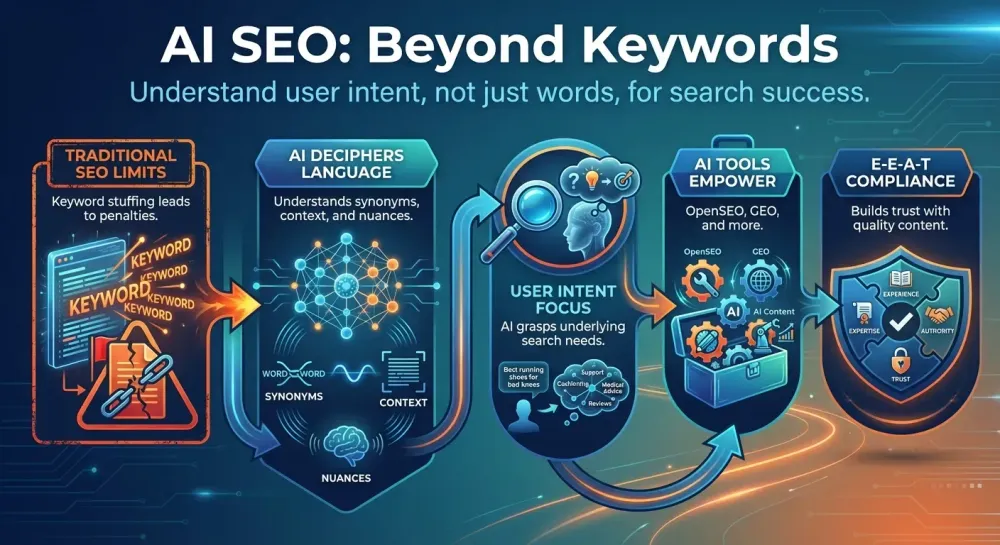
Tools like OpenSEO are revolutionizing content marketing for beginners and experienced professionals alike. OpenSEO offers a suite of AI-powered features designed to streamline the entire SEO process. This includes intelligent keyword research, deep article generation that produces structured and comprehensive content, and built-in SEO scoring to refine your work before publication.

Furthermore, OpenSEO's AI models are trained on high-ranking SEO articles, enabling them to naturally incorporate principles that search engines favor. This AI-driven approach helps create content that is not only user-centric but also optimized for search engine algorithms.

Understanding E-E-A-T: Expertise, Experience, Authoritativeness, Trustworthiness

Google's E-E-A-T guidelines are paramount for ranking, especially for topics related to "Your Money or Your Life" (YMYL). Demonstrating Expertise, Experience, Authoritativeness, and Trustworthiness are critical. This means backing up claims with evidence, highlighting author credentials, and ensuring your website is secure and transparent. OpenSEO's AI models assist in this by generating content that aligns with these principles.

As the digital landscape continues to evolve, understanding the nuances of modern SEO is paramount. Beyond fundamental keyword optimization, advanced strategies are emerging to address new search paradigms and user behaviors.

The Rise of Generative AI in Search and Content Creation

Generative AI is fundamentally reshaping how users find information and consume content. The advent of sophisticated AI models means that search is becoming more conversational and intent-driven. Understanding this shift is vital for any SEO strategy.

Optimizing for 'Generative Engine Optimization' (GEO)

OpenSEO is at the forefront of this evolution, focusing on Generative Engine Optimization (GEO). This approach ensures your content is structured and semantically rich, making it highly discoverable by emerging AI-driven search interfaces. GEO complements traditional SEO, ensuring your brand is visible in both current and future search ecosystems.

Seamless Integration of Content Creation and Publishing

Streamlining your workflow is key to scaling content efforts. OpenSEO's seamless integration with platforms like WordPress exemplifies this. This allows for efficient content publishing, from AI-generated drafts to final, optimized posts, directly to your website.

Mobile-First Indexing and Core Web Vitals

In today's mobile-dominated world, a superior mobile experience and fast page load speeds are non-negotiable for good SEO rankings. Google's mobile-first indexing means it primarily uses the mobile version of your content for ranking. Core Web Vitals, measuring loading, interactivity, and visual stability, are direct ranking factors.

Local SEO: Reaching Your Local Audience

For businesses targeting a local customer base, robust local SEO strategies are essential. This involves optimizing your online presence to attract customers searching for businesses in your geographic area, utilizing tools like Google Business Profile and location-specific keywords.

6. Measuring Your SEO Success and Continuous Improvement

Understanding what is SEO involves not just implementation but also diligent measurement. Tracking key SEO metrics is crucial for gauging your website's performance and identifying areas for growth.

Key SEO Metrics to Track

Monitor metrics like organic traffic, keyword rankings, bounce rate, conversion rate, and backlinks. These provide a clear picture of your content's visibility and user engagement.

Understanding Analytics Tools

Leverage tools like Google Analytics and Google Search Console. They offer invaluable insights into user behavior, search queries, and technical SEO health.

Practical Implication: These tools are your primary source for understanding how users interact with your site and how search engines perceive it.

Actionable Tip 1: Regularly review your Google Search Console for any crawl errors or indexing issues. Addressing these promptly can significantly improve your site's visibility.

Actionable Tip 2: Use Google Analytics to identify your top-performing content and understand which pages users spend the most time on. This insight can guide your future content creation efforts.

The Iterative Nature of SEO: Analyze, Adapt, and Optimize

SEO is an ongoing journey. Regularly analyze your data to identify what's working and what needs improvement. This iterative process of analysis, adaptation, and optimization is key to sustained success.

The Role of AI in Performance Analysis and Optimization

AI-powered tools, like the article scoring feature in OpenSEO, can provide actionable data-driven recommendations for optimizing content and improving rankings. OpenSEO helps refine your content for better search engine and AI engine understanding, ensuring your efforts align with current search trends.

FAQ (Frequently Asked Questions)

Q1: What is the most important aspect of SEO for beginners in 2025?

A1: For beginners in 2025, the most important aspect of SEO is to focus on creating high-quality, user-centric content that genuinely answers search queries. This, combined with foundational keyword research and ensuring a good user experience (UX), will provide a strong base for your SEO efforts.

Q2: How does AI impact SEO for beginners?

A2: AI significantly impacts SEO by offering tools that streamline complex tasks like keyword research, content generation, and performance analysis. For beginners, AI can democratize SEO by making sophisticated optimization strategies more accessible and efficient, helping them create optimized content faster.

Q3: Is link building still important for SEO in 2025?

A3: Yes, link building remains a crucial ranking factor in 2025. Backlinks from reputable websites act as strong endorsements, signaling authority and trustworthiness to search engines. While the methods of acquiring links evolve, the principle of earning quality links from relevant sources is as important as ever.

Q4: What are Core Web Vitals and why do they matter for SEO?

A4: Core Web Vitals are a set of metrics (Largest Contentful Paint, First Input Delay, and Cumulative Layout Shift) that measure user experience on a webpage, focusing on loading speed, interactivity, and visual stability. They are direct ranking factors for Google, meaning a better score can improve your search engine rankings and user satisfaction.

Conclusion

In conclusion, demystifying what is SEO for beginners in 2025 reveals a landscape that is both inherently strategic and remarkably dynamic. By mastering the foundational pillars of on-page, off-page, and technical SEO, and by prioritizing the creation of high-quality, user-centric content, you are not just learning about SEO; you are building a robust platform for sustained online success.

The advent of AI-powered solutions, such as OpenSEO, is a game-changer, significantly lowering the entry barrier and empowering you with intelligent tools for everything from pinpoint keyword research and efficient content generation to insightful performance analysis.

The key takeaway is that SEO is not a static endpoint but an exhilarating, ongoing journey. It demands continuous learning, agile adaptation to evolving algorithms, and a commitment to constant improvement. Therefore, our actionable recommendation is clear: embrace these fundamental strategies and actively leverage the transformative power of modern SEO tools. Start implementing what you've learned today – begin by researching your target keywords, optimizing your existing content, and exploring how tools like OpenSEO can accelerate your progress. Don't wait to drive organic traffic, build your brand authority, and confidently achieve your online aspirations in the ever-evolving digital arena of 2025 and well into the future. Take the first step and unlock your SEO potential now!

Featured Posts