What is SEO? Your Beginner's Guide to Search Engine Optimization

Image source: Pexels
Ever feel like your website is a hidden gem, lost in the vastness of the internet? In today's digital landscape, simply having a website isn't enough; you need to be discoverable. This is precisely where the magic of Search Engine Optimization (SEO) comes into play. If the term "what is SEO" sounds intimidating, think of it as your roadmap to getting found online. It's not about complex coding or insider secrets, but rather about making your online content clear, relevant, and valuable to both search engines like Google and, most importantly, the people actively searching for what you offer.
This comprehensive guide is designed for absolute beginners, breaking down the fundamental principles of SEO. We'll explore exactly what SEO is, why it's an indispensable tool for your online success, and provide you with actionable insights to start attracting the right kind of visitors to your site, helping you achieve your digital aspirations.
1. What Exactly is SEO? Demystifying the Acronym
Search Engine Optimization, commonly known as SEO, is a fundamental aspect of digital presence. At its core, what is SEO? It's the strategic practice of enhancing a website's visibility within search engine results pages (SERPs). This process is crucial for attracting "organic," or unpaid, traffic from search engines like Google and Bing.
Breaking Down 'Search Engine Optimization'
The term "Search Engine Optimization" itself breaks down into its core components: "Search Engine" refers to platforms like Google that users employ to find information, and "Optimization" signifies the act of making something as effective as possible. Therefore, SEO is about making your website the most effective and visible answer to a user's search query.
The Core Goal: Visibility and Organic Traffic
The primary objective of SEO is to drive relevant, high-quality traffic to a website without the need for paid advertising. This involves understanding user intent – what a person is truly looking for when they type a query into a search engine – and then aligning your website's content and structure to meet that need. Search engines, in turn, aim to provide the most authoritative and relevant answers to these queries. Tools like OpenSEO are designed to help content creators produce articles that align with these search engine preferences, ensuring content is user-friendly and discoverable.
Why Search Engines Matter in Today's Digital Landscape
In today's digital-first world, search engines are the primary gateway to information and services. A strong SEO strategy ensures that when potential customers or readers are actively searching for what you offer, your website appears prominently in the results. This organic visibility builds trust and credibility, making it an indispensable component of any successful online marketing effort.
2. The 'Why' Behind SEO: Benefits for Your Online Presence
Understanding what is SEO is crucial for anyone looking to establish a robust online presence. Search Engine Optimization allows your website to be discovered by users actively seeking information, products, or services you offer. It’s not just about being online; it’s about being found by the right people at the right time, driving tangible results for your digital endeavors.
Boosting Website Traffic and Lead Generation
Higher search rankings directly translate to increased visibility. When your website appears at the top of search engine results pages (SERPs), it naturally garners more clicks and, consequently, more website visitors. This influx of targeted traffic is invaluable for lead generation. For instance, a study by OpenSEO highlights how their AI-driven content strategies, focused on SEO principles, have led to significant traffic increases for their clients. This consistent flow of interested users is the lifeblood of any online business, directly impacting conversion rates and revenue.
Building Credibility and Trust with Users
Appearing prominently in search results isn't just about visibility; it's about building authority and trust. Users tend to perceive websites that rank higher as more credible and trustworthy. When your brand is consistently visible for relevant searches, it signifies expertise and reliability. This perceived authority, often a byproduct of effective SEO, encourages users to engage more deeply with your content and consider your offerings.
Achieving Long-Term, Sustainable Growth
Unlike paid advertising, which ceases to provide traffic once the budget is depleted, SEO offers a sustainable and long-term growth strategy. The efforts invested in optimizing your website contribute to a consistent stream of organic traffic that can endure over time. This cost-effectiveness, a key benefit of mastering what is SEO, ensures your marketing spend yields lasting returns, fostering steady expansion without continuous financial outlay.
Understanding Your Audience Better Through Search Data
SEO provides invaluable insights into user behavior and search intent. By analyzing search data, you can understand precisely what people are searching for, the language they use, and the problems they are trying to solve. This data-driven understanding is instrumental in refining your content strategy and even informing product development. Tools like OpenSEO's keyword research capabilities allow businesses to tap into this data, ensuring their content directly addresses audience needs and drives relevant traffic.
3. The Pillars of SEO: On-Page, Off-Page, and Technical SEO
Understanding what is SEO involves recognizing its foundational pillars. Search engine optimization is the practice of enhancing a website's visibility in search engine results for organic, unpaid traffic. This multifaceted discipline relies on three interconnected components working in synergy to improve search rankings and attract targeted visitors. Each pillar plays a crucial role in how search engines perceive and rank your online presence.
On-Page SEO: Optimizing Your Content and HTML
On-page SEO focuses on optimizing elements directly within your website. This includes strategic keyword integration within high-quality, engaging content, ensuring meta descriptions accurately summarize page content, and utilizing clear heading structures (H1, H2, etc.) for readability. Furthermore, optimizing image alt text helps search engines understand visual content and improves accessibility. Tools like OpenSEO can assist in generating content that naturally incorporates these elements, ensuring a strong foundation for search engine understanding.
Off-Page SEO: Building Authority and Reputation
Off-page SEO involves external signals that contribute to your website's authority and reputation. The most significant of these are backlinks from reputable and relevant websites, which act as votes of confidence. Social media mentions, brand reputation, and online reviews also play a vital role. Building these external signals demonstrates to search engines that your site is a trusted and valuable resource.
Technical SEO: Ensuring Search Engines Can Access and Understand Your Site
Technical SEO is the backbone that allows search engines to effectively crawl, index, and understand your website. This encompasses optimizing site speed for a better user experience, ensuring mobile-friendliness for a growing mobile audience, and creating sitemaps and robots.txt files to guide search engine crawlers. Implementing structured data helps search engines better interpret your content, and a well-defined site architecture ensures logical navigation. These technical aspects are crucial for search engines to access and process your information efficiently.
4. Keyword Research: The Foundation of Effective SEO
Understanding what is SEO begins with recognizing the critical role of keyword research. Keywords are the fundamental terms and phrases users type into search engines when seeking information, products, or services. Effectively matching your content to these relevant keywords is paramount for attracting the right audience and ensuring your website is discoverable.
What are Keywords and Why Do They Matter?
Keywords act as the bridge between user intent and your content. When users search for "best coffee maker," they expect to find information about coffee makers. If your content addresses this query, you have a higher chance of appearing in their search results. This alignment is crucial for driving targeted traffic.
Types of Keywords: Short-Tail vs. Long-Tail
Keywords can be broadly categorized into short-tail (e.g., "SEO") and long-tail (e.g., "how to do keyword research for beginners"). While short-tail keywords have higher search volume, they also face intense competition. Long-tail keywords, being more specific and often longer phrases, typically have lower competition and attract users with a clearer intent, leading to higher conversion rates.
Tools and Strategies for Finding the Right Keywords
Numerous tools can assist in this vital process. Platforms like Google Keyword Planner, SEMrush, and Ahrefs offer robust features for identifying search volume, competition, and related terms. OpenSEO's intelligent keyword research is a prime example of how modern AI can assist, helping to uncover high-search volume, low-competition long-tail keywords, ensuring your content targets lucrative niches.
Integrating Keywords Naturally into Your Content
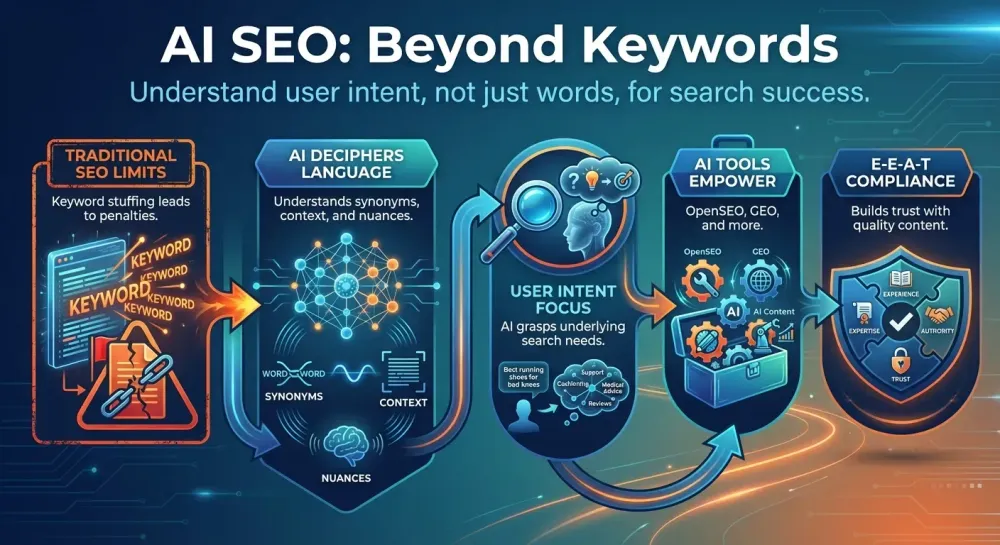
Once keywords are identified, their integration must be seamless. Keyword stuffing—overusing keywords unnaturally—is detrimental to both user experience and SEO rankings. Focus on incorporating keywords organically within your content, ensuring it reads naturally and addresses the user's underlying intent. This approach, central to effective SEO, makes your content valuable and discoverable.
5. Creating SEO-Friendly Content: Quality and User Experience
In the realm of digital marketing, understanding what is SEO is fundamental to driving organic traffic. At its core, SEO is about optimizing your website and its content to rank higher in search engine results pages (SERPs), making it easier for users to find what they're looking for. This section delves into how to create content that not only appeals to search engines but, more importantly, provides exceptional value to your audience.
Content is King (and Queen): What Makes it 'SEO-Friendly'?
High-quality, original, and valuable content is paramount for effective SEO. Content is considered 'SEO-friendly' when it directly answers user queries, offers comprehensive information, and keeps visitors engaged. This means going beyond superficial information to provide depth and unique insights. Think of it as building a trusted resource that users will return to.
The Role of AI in Content Creation: Efficiency and Quality
AI tools are revolutionizing content creation, offering both efficiency and enhanced quality. They can significantly streamline the process, helping to produce structured and rich articles with remarkable speed. For instance, OpenSEO's AI deep article generation is designed to assist in creating well-structured content, automatically incorporating appropriate H-tags and bolded key phrases. This not only saves time but also ensures a higher standard of readability and search engine optimization from the outset.
Structuring Your Content for Readability and Search Engines
Effective content structure is crucial for both user experience and search engine crawling. Clear headings, subheadings, short paragraphs, and bullet points break up text, making it easier for readers to digest information quickly. This improved readability signals to search engines that your content is user-friendly and well-organized.
The Importance of E-E-A-T (Experience, Expertise, Authoritativeness, Trustworthiness)
E-E-A-T is a critical concept for SEO, particularly for certain industries where trust is paramount. It signifies that your content is backed by genuine experience, demonstrable expertise, recognized authoritativeness, and unwavering trustworthiness. Search engines prioritize content that meets these criteria, as it indicates reliability and value to the user. Tools like OpenSEO are built with SEO-oriented algorithms that understand and aim to align with E-E-A-T standards, making it easier to produce content that search engines deem credible.
6. Beyond Content: The Evolving Landscape of SEO
The fundamental question of what is SEO is rapidly expanding. As advanced AI models emerge, the way users discover information is transforming. This evolution necessitates a broader approach to online visibility, moving beyond traditional search engine optimization.
The Rise of Generative AI and its Impact on Search
Generative AI is fundamentally altering search. Users are increasingly interacting with AI-powered interfaces for information retrieval, making it crucial to adapt SEO strategies to these new platforms.
Optimizing for AI Search Engines: GEO Strategies
OpenSEO pioneers Generative Engine Optimization (GEO) strategies. These techniques are designed to ensure your brand and content are discoverable by future search interfaces driven by generative AI, like those powering ChatGPT or Gemini.
The Seamless Integration of Content Creation and Publishing
Tools like OpenSEO offer seamless WordPress integration, automating the process of publishing high-quality, SEO-optimized content. This streamlines workflow, allowing for efficient content deployment.
Measuring Your SEO Success: Key Metrics to Track
To gauge effectiveness, key metrics include organic traffic, keyword rankings, bounce rate, conversion rates, and backlinks. Tracking these provides insights into your SEO performance and guides future optimization efforts.
FAQ (Frequently Asked Questions)
Q1: What is the primary goal of SEO?
A1: The primary goal of SEO is to increase a website's visibility in search engine results pages (SERPs) to drive relevant, organic (unpaid) traffic to the site.
Q2: What are the three main pillars of SEO?
A2: The three main pillars of SEO are On-Page SEO (optimizing content and HTML on your site), Off-Page SEO (building authority through external signals like backlinks), and Technical SEO (ensuring search engines can crawl and index your site effectively).
Q3: How important is keyword research in SEO?
A3: Keyword research is foundational to effective SEO. It involves identifying the terms and phrases your target audience uses to search for information, products, or services, which then guides your content creation and optimization efforts.
Q4: Can AI tools help with SEO?
A4: Yes, AI tools can significantly aid in SEO by assisting with keyword research, content generation, structuring articles, and even identifying optimization opportunities, making the process more efficient and effective.
Conclusion
In essence, understanding what is SEO is far more than just a technical jargon to be feared; it's the cornerstone of building a successful and visible online presence. We've demystified this powerful discipline, revealing it as a continuous journey, not a destination. By focusing on the fundamental pillars of on-page optimization, building off-page authority, and ensuring your website's technical health, you're actively paving the way for your content to be discovered by those actively seeking it. Remember, the ultimate aim of SEO is to seamlessly connect your valuable offerings with your target audience.
Don't let the initial learning curve deter you. Embrace the power of SEO by starting with small, consistent steps. Begin by auditing your current website for technical issues, identifying keywords your audience is using, and creating high-quality, user-centric content that answers their questions. Explore the wealth of free and paid SEO tools available to help you track your progress and refine your strategies. The sooner you begin implementing these foundational concepts, the sooner you'll witness a significant uplift in your search engine rankings and, more importantly, in your overall online impact. Start your SEO journey today, and unlock the potential for your business to thrive in the digital landscape!