AI SEO for Search Dominance in 2025: Master the Future

The AI SEO Revolution: Understanding the Shift in Search
The landscape of online visibility is undergoing a seismic shift, driven by the pervasive influence of artificial intelligence. This evolution marks a departure from traditional SEO practices, ushering in an era where understanding user intent and leveraging advanced AI technologies are paramount for achieving top search rankings. The rise of AI SEO is not just an incremental update; it's a fundamental redefinition of how search engines operate and how content is optimized.
What Exactly is AI SEO?
AI SEO (Artificial Intelligence Search Engine Optimization) fundamentally integrates sophisticated AI technologies like machine learning (ML), natural language processing (NLP), and large language models (LLMs) into search engine optimization strategies. This integration allows for a deeper, more nuanced understanding of search queries and user behavior. Platforms are emerging to support this, such as OpenSEO, which offers intelligent keyword research, AI-powered content generation, and comprehensive SEO scoring to maximize traffic growth.
Why 2025 is the Year of AI SEO Dominance
2025 is poised to be the year AI SEO solidifies its dominance due to the accelerating sophistication of AI in search algorithms. Search engines are moving beyond simple keyword matching to comprehending context and intent. This necessitates a new approach to optimization. Terms like GEO (Generative Engine Optimization) and AEO (Answer Engine Optimization) are gaining traction, reflecting a focus on optimizing content for generative AI responses and direct answers, respectively. AI's ability to personalize search results and user experiences further amplifies its importance.
The Evolution of Search: From Keywords to Intent
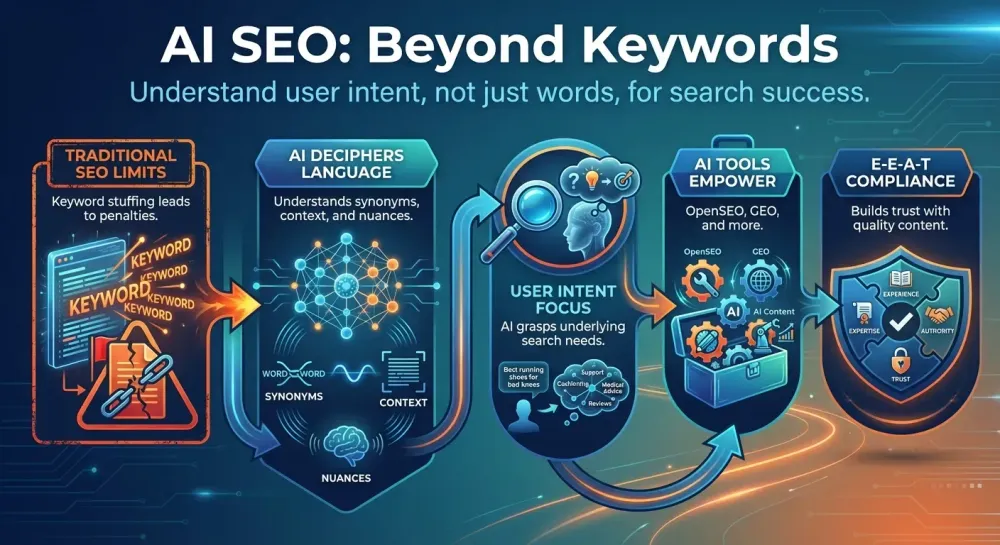
The evolution of search is characterized by a dramatic shift from traditional keyword stuffing to a profound understanding of user intent and context. Search engines are increasingly adept at discerning what a user means rather than just what they type. This means content must be comprehensive, contextually relevant, and directly address the underlying needs of the searcher. AI tools are crucial in this transition, assisting in identifying nuanced user intents and generating content that satisfies them, thereby driving organic traffic and enhancing user engagement.
Leveraging AI for Strategic Keyword Research and Content Ideation
In today's dynamic digital landscape, traditional keyword research often falls short of identifying true content opportunities. AI-powered tools are revolutionizing this process, moving beyond basic volume and competition metrics to uncover deeper insights. This shift is crucial for effective AI SEO strategies, enabling content creators to align with both user intent and algorithmic preferences.
Beyond Basic Keyword Tools: AI-Powered Discovery
The limitations of traditional keyword tools become apparent in the AI era. They often fail to grasp the nuances of search intent or predict emerging trends. AI tools like OpenSEO, however, excel at this. They can identify high-volume, low-competition keywords by analyzing vast datasets and understanding semantic relationships. This allows for a more strategic approach, ensuring content development is grounded in genuine search demand.
Uncovering High-Potential Long-Tail Keywords
AI's analytical power is particularly adept at discovering high-potential long-tail keywords. By analyzing user queries and conversational patterns, tools can pinpoint niche topics and specific questions users are asking. This capability, as demonstrated by OpenSEO's intelligent keyword analysis, ensures that content is not only discoverable but also highly relevant to a targeted audience, capturing valuable, often overlooked, search traffic.
Topic Clustering and Semantic Relevance
Leveraging AI for topic clustering and semantic relevance is key to creating authoritative content. By understanding how keywords and topics relate to each other, AI can help brainstorm content ideas that resonate deeply with target audiences and search engines alike. This approach ensures that a website builds topical authority, a critical factor in modern AI SEO, and addresses user needs comprehensively, leading to improved rankings and engagement.
AI-Assisted Content Creation: Crafting High-Quality, Search-Optimized Articles
Leveraging artificial intelligence is revolutionizing how content is produced, making it more efficient, structured, and aligned with search engine best practices. AI tools can now assist in generating comprehensive articles that not only resonate with users but also rank well. This is particularly crucial in today's evolving search landscape, where tools like OpenSEO are at the forefront of this transformation.
The Power of Generative AI in Content Production
Generative AI, as exemplified by platforms like OpenSEO, offers a powerful solution for content marketers. It moves beyond simple text generation to create structured, logical, and in-depth articles. By inputting a topic or keyword, AI can produce content that is inherently well-organized, saving significant time and effort. This capability is vital for producing high-quality content consistently, a cornerstone of effective AI SEO.
Ensuring Readability and Structure with AI
A key benefit of AI-assisted content creation is its ability to automate the inclusion of crucial on-page SEO elements. Tools can automatically integrate H-tags to create a clear hierarchy, bold key phrases for emphasis, and ensure a logical flow of information. This meticulous attention to structure enhances readability for users and signals to search engines that the content is well-organized and easy to understand, contributing to better AI SEO performance.
Meeting E-E-A-T Standards with AI-Generated Content
Meeting E-E-A-T (Experience, Expertise, Authoritativeness, Trustworthiness) standards is paramount for search engine rankings. AI plays a significant role in producing content that aligns with these principles. Platforms like OpenSEO are trained on vast datasets of high-ranking articles, enabling their AI models to naturally incorporate elements that demonstrate authority and trustworthiness. By generating in-depth, well-researched content, AI-driven tools help establish a strong foundation for E-E-A-T, making it easier to achieve better AI SEO outcomes. OpenSEO's approach, including its GEO (Generative Engine Optimization) enhancements, specifically focuses on optimizing content for both traditional search engines and emerging generative AI search interfaces. Furthermore, its seamless WordPress integration allows for efficient publishing and scaling of this AI-optimized content.
Optimizing for Generative AI Engines: The Future of Content Visibility
The landscape of online visibility is rapidly evolving, shifting from traditional search engine optimization (SEO) to a more nuanced approach that anticipates the intelligence of generative AI. This new era demands a strategic pivot towards AI SEO, where content is not just discoverable by algorithms but actively recommended and understood by advanced AI models.
Understanding GEO: Optimizing for AI Recommendations
Introducing Generative Engine Optimization (GEO) as a forward-thinking strategy is crucial. GEO focuses on structuring content to be easily understood and recommended by generative AI models. This involves more than just keywords; it means crafting content that AI can readily process, interpret, and integrate into its vast knowledge base. OpenSEO, for instance, champions this by prioritizing content structure and semantic relevance, ensuring your brand is positioned for AI-driven discovery.
Semantic Optimization and Contextual Relevance
The importance of semantic connections and contextual depth cannot be overstated. Generative AI thrives on understanding the nuances of language and the relationships between concepts. Deeply researched, contextually rich content, where ideas flow logically and are supported by robust information, is more likely to be deemed authoritative and relevant by AI. This prepares content for AI-driven search interfaces and conversational search, where users expect direct, comprehensive answers.
The Rise of AI-Powered Search Interfaces
As AI increasingly powers search interfaces, content must be optimized for this new paradigm. This means moving beyond keyword stuffing to creating content that answers questions comprehensively and provides the underlying context AI models seek. OpenSEO’s approach, which includes AI-driven article generation with structured headings and key sentence emphasis, directly addresses this need, ensuring content is not only SEO-friendly but also highly digestible for AI engines, ultimately enhancing AI SEO performance and future visibility.
Seamless Integration and Workflow Automation with AI SEO Tools
Leveraging AI SEO tools is transforming how businesses approach online visibility. By automating repetitive tasks and providing intelligent insights, these platforms allow for a more strategic and efficient SEO workflow, ultimately driving better results.
Streamlining Content Publishing: The WordPress Advantage
The seamless integration of AI SEO tools with platforms like WordPress is a game-changer. Tools such as OpenSEO (open-seo.top) eliminate the tedious manual process of transferring content. This integration allows for the one-click publishing of AI-generated articles directly to your WordPress site. Crucially, it supports the automatic configuration of essential elements like featured images, categories, and tags, ensuring that newly published content is immediately organized and optimized for discoverability.
Automating SEO Tasks for Scale and Efficiency
The efficiency gains from automating repetitive SEO tasks are substantial. AI SEO solutions excel at handling high-volume content creation and optimization. This automation frees up valuable human resources, enabling SEO professionals to shift their focus from manual execution to higher-level strategic planning. By automating tasks like keyword research and content structuring, businesses can scale their SEO efforts effectively, ensuring consistent output and improved search engine performance.
The Role of AI in Technical SEO and Auditing
AI's capabilities extend to the critical realm of technical SEO. AI-powered tools can autonomously scan websites to identify and flag technical SEO issues that might otherwise go unnoticed. This includes detecting broken links, slow page load times, and other site errors that can negatively impact rankings. By automating these audits, AI ensures that websites remain healthy and optimized, allowing teams to concentrate on content and strategy rather than manual diagnostics. This proactive approach is key to maintaining a strong online presence.
Measuring Success and Adapting to the Evolving AI SEO Landscape
Successfully navigating the dynamic world of AI SEO requires a proactive and data-informed approach. As artificial intelligence reshapes search engine algorithms and user interaction, continuous measurement and adaptation are paramount for sustained visibility and organic growth.
AI-Powered SEO Analytics and Performance Tracking
Leveraging AI for advanced SEO analytics is crucial for understanding complex data patterns and predicting future trends. Tools like OpenSEO offer sophisticated dashboards that go beyond traditional metrics, providing insights into content performance and user engagement driven by AI. This allows for more precise identification of what resonates with both search engines and audiences, enabling data-driven optimizations.
Interpreting AI-Driven Content Scores
Understanding and acting on AI-generated content scoring is a key component of modern AI SEO. Platforms such as OpenSEO provide detailed analyses, scoring content on factors like keyword density, readability, and E-E-A-T principles. These scores offer actionable recommendations, guiding users to refine their content for maximum impact and better search engine rankings.
Staying Ahead: Continuous Learning and Adaptation
The AI SEO landscape is in constant flux due to evolving algorithms and search engine behaviors. A flexible strategy, underpinned by continuous learning and adaptation, is essential. By monitoring AI algorithm updates and embracing data-driven adjustments, businesses can maintain their competitive edge. The long-term benefits of embracing AI for sustainable search dominance are significant, fostering efficiency and improved organic traffic.
FAQ (Frequently Asked Questions)
Q1: What is the primary difference between traditional SEO and AI SEO?
A1: Traditional SEO primarily focused on keyword matching and on-page optimization. AI SEO, on the other hand, leverages artificial intelligence to understand user intent, context, and semantic relationships, enabling a more nuanced and personalized approach to content creation and optimization for both search engines and emerging AI-powered search interfaces.
Q2: How can AI tools help with keyword research for AI SEO?
A2: AI tools can analyze vast datasets to identify not just high-volume keywords, but also long-tail keywords, user intent behind queries, and emerging trends. They can also help with topic clustering and understanding semantic relevance, ensuring content aligns with what users are truly searching for and what AI algorithms prioritize.
Q3: Is AI-generated content reliable for E-E-A-T standards?
A3: AI-generated content can be highly reliable for E-E-A-T standards when used appropriately. Platforms trained on high-quality data can produce well-researched, structured, and authoritative content. However, human oversight is still crucial to ensure accuracy, add unique insights, and verify factual information to fully meet E-E-A-T requirements.
Q4: What is Generative Engine Optimization (GEO) and why is it important?
A4: GEO is a strategic approach to optimizing content specifically for generative AI models. It focuses on structuring content in a way that AI can easily process, interpret, and recommend. This involves prioritizing semantic relevance, contextual depth, and clear organization, ensuring content is discoverable and valuable within AI-driven search experiences.
Conclusion: Your AI-Powered Ascent to Search Dominance
The landscape of online visibility has irrevocably transformed with the advent of AI SEO. As we navigate towards 2025, it's clear that a mere adherence to traditional SEO tactics is no longer sufficient for achieving search dominance. Instead, the future belongs to a sophisticated, intent-driven, and automated approach powered by artificial intelligence. By harnessing the capabilities of AI-powered tools, such as the innovative OpenSEO, businesses and individuals can unlock unprecedented levels of efficiency, revolutionizing keyword research, content creation, and ongoing optimization.
To truly secure your position at the forefront of search in 2025, it is imperative to not just understand, but actively integrate these advanced AI capabilities. This strategic adoption ensures your content will not only ascend the search rankings but, crucially, will resonate deeply with your target audience and be recognized by the evolving algorithms of next-generation search engines. The path to search supremacy is paved with continuous learning and adaptation. Therefore, stay agile, experiment boldly with AI-driven strategies, and embrace AI as your indispensable co-pilot.Don't just react to the future of search; actively shape it. Start integrating AI SEO into your strategy today and command your digital destiny.