AI SEO Tools: Shaping Content Creation in 2025

At the heart of this transformation lie AI SEO tools. These powerful platforms are fundamentally reshaping how you conceive, generate, and refine content for maximum search engine impact. These intelligent solutions democratize advanced SEO strategies, empowering you to uncover hidden opportunities, craft engaging articles at scale, and ultimately achieve greater visibility and traffic.
This article dives deep into how these groundbreaking AI SEO tools are redefining your content creation process. We'll explore their core functionalities, the unique advantages they offer, and the exciting future they are building for digital marketers and website owners.
The Evolving Search Landscape and the Rise of AI SEO Tools
The digital search environment is in constant flux, driven by algorithms that prioritize user experience and content quality. This necessitates a strategic approach to online visibility, where AI SEO tools are becoming indispensable. As search engines continually refine their ranking factors, the demand for comprehensive, relevant, and engaging content that directly answers user queries has never been higher.
The Constant Flux of Search Algorithms
Search engine algorithms are dynamic systems that adapt to user behavior and evolving content standards. Strategies effective yesterday may not be sufficient today. Staying ahead requires understanding these shifts and adopting tools that can help navigate them.
The Growing Demand for High-Quality, User-Centric Content
Users today expect more than just keyword-stuffed pages. They seek in-depth, well-researched, and engaging content that provides genuine value. This user-centric approach is a cornerstone of modern SEO, directly impacting rankings and audience engagement.
What Exactly Are AI SEO Tools?
AI SEO tools leverage artificial intelligence to streamline and enhance various aspects of search engine optimization. From intelligent keyword research to AI-driven content creation and in-depth performance analysis, these tools boost efficiency and effectiveness.
Platforms like OpenSEO exemplify this trend, offering features such as smart keyword analysis, AI-powered article generation with SEO optimization (including H-tags and bolding), and detailed content scoring systems. OpenSEO also highlights advanced GEO (Generative Engine Optimization) for AI search engines and seamless WordPress integration. This demonstrates how AI is moving beyond a novelty to become a necessity for a competitive digital presence.
| AI SEO Tool Feature | OpenSEO | Semrush One | Surfer SEO |
|---|---|---|---|
| Keyword Research | ✓ | ✓ | ✓ |
| AI Content Generation | ✓ | ✓ | ✓ |
| SEO Content Scoring | ✓ | ✓ | ✓ |
| WordPress Integration | ✓ | ||
| GEO Optimization | ✓ |
Core Capabilities of Modern AI SEO Tools
The landscape of search engine optimization is rapidly evolving, with AI SEO tools at the forefront of this transformation. These advanced platforms offer sophisticated functionalities that streamline content creation, optimization, and performance analysis, moving far beyond basic keyword suggestions. Tools like OpenSEO exemplify this shift, providing a comprehensive suite designed to maximize SEO impact and drive organic traffic.
Intelligent Keyword Research and Topic Discovery
Modern AI SEO tools excel at uncovering lucrative opportunities. They identify high-volume, low-competition long-tail keywords and pinpoint trending topics that resonate with target audiences. This deep dive into keyword potential, as emphasized by OpenSEO, ensures content is built on a solid foundation of genuine search demand, preventing wasted effort on topics with limited reach. This intelligent discovery phase is crucial for strategic content planning.
AI-Powered Content Generation: From Ideas to Drafts
One of the most significant advancements is the capability of advanced AI models to generate structured, logical, and in-depth articles from simple prompts. This feature dramatically saves time and resources for content creators. Tools now produce comprehensive drafts that are not only relevant to chosen keywords but also engaging for the reader. This transforms the initial ideation phase into rapid generation of quality content, paving the way for faster publication cycles.
On-Page Optimization and Content Enhancement
Beyond initial generation, AI SEO tools integrate robust on-page optimization features. Standard functionalities include automatic H-tag placement, bolding key phrases for emphasis, and ensuring overall readability. These tools analyze content for keyword density, semantic relevance, and user experience signals, providing actionable recommendations. OpenSEO's article scoring system offers detailed feedback on multiple SEO factors, helping to refine content before it goes live, ensuring it’s primed for search engine visibility and user engagement.
Performance Analysis and Iterative Improvement
The iterative nature of SEO is greatly enhanced by AI. These tools provide data-driven insights into content performance, identifying what's working and what's not. They suggest specific optimizations for better search rankings and user engagement, creating a continuous feedback loop. By analyzing metrics like traffic, dwell time, and conversion rates, AI pinpoints areas for improvement, allowing marketers to refine their strategies effectively. This analytical prowess ensures content marketing efforts remain agile and responsive to algorithm updates and audience behavior.
Beyond Traditional SEO: The GEO Advantage and Future-Proofing Content
As search engines evolve, so too must our content optimization strategies. Moving beyond conventional SEO, the burgeoning concept of GEO (Generative Engine Optimization) is reshaping how we prepare content for an AI-driven future. This shift acknowledges that simply satisfying traditional search algorithms is no longer sufficient.
Understanding GEO (Generative Engine Optimization)
GEO focuses on optimizing content not just for traditional search engines but also for generative AI models. This involves structuring content semantically and logically to be easily understood and recommended by AI assistants. Tools like OpenSEO pioneer this approach, ensuring content is readable by humans and digestible by AI. By focusing on clear hierarchies, semantic relationships, and comprehensive information, creators increase the likelihood of their content being surfaced and recommended by AI search interfaces.
Optimizing for Emerging AI Search Interfaces
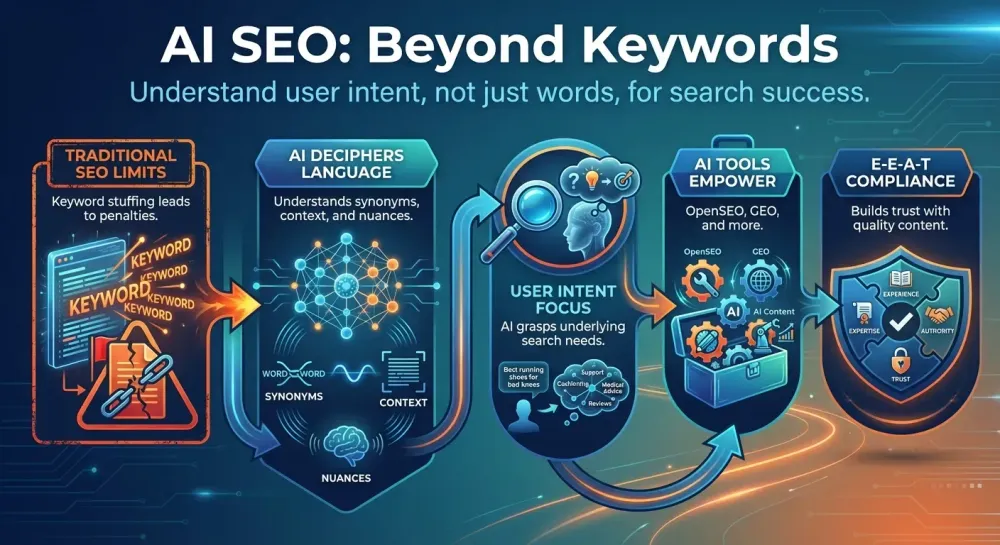
The rise of AI chatbots and conversational search means content needs to be more than just keyword-rich; it must be contextually relevant and authoritative. As AI plays a larger role in search results, ensuring content aligns with E-E-A-T (Experience, Expertise, Authoritativeness, Trustworthiness) is crucial. AI SEO tools are adapting to help creators build content that signals credibility and value to both users and advanced AI models. This includes generating detailed, well-researched pieces that demonstrate genuine expertise, a key factor for AI recommendation engines.
The Role of AI in E-E-A-T and Content Authority
AI SEO tools are increasingly vital for demonstrating E-E-A-T. OpenSEO, for instance, employs AI models trained on high-ranking articles to ensure generated content meets these stringent standards. This allows creators to build content that signals authenticity and trustworthiness, essential for both user trust and AI-driven visibility. The future of SEO lies in creating content that not only ranks but also resonates deeply with both human users and the intelligent systems that will increasingly mediate their search experiences.
Streamlining Workflows: Integration and Automation
In today's fast-paced digital landscape, efficiency is paramount. Modern AI SEO tools revolutionize content marketing by focusing on seamless integration and intelligent automation, empowering creators and teams to achieve more with less effort. This shift allows for a strategic focus on growth rather than getting bogged down in manual processes.
Seamless Content Publishing with Platform Integrations
The days of cumbersome copy-pasting are rapidly fading. Leading AI SEO tools now offer direct integrations with popular Content Management Systems (CMS) like WordPress. This means users can generate optimized content and publish it to their websites with a single click. This capability extends beyond basic publishing, encompassing automated setting of featured images, categories, and tags. OpenSEO's robust WordPress integration exemplifies how these tools simplify the entire content lifecycle, transforming a multi-step process into an immediate action.
Automating Repetitive Tasks for Scalability
Automation is key to scaling content production without sacrificing quality. By automating routine tasks, AI SEO tools free up valuable time for content marketing teams and individual creators. This allows them to concentrate on higher-level strategic thinking, campaign planning, and audience engagement. The ability to create and publish content at scale is no longer a challenge for large organizations alone; these integrated solutions democratize advanced content marketing capabilities, empowering individual website owners and small teams to compete effectively.
The Impact on Content Marketing Teams and Individual Creators
The integration and automation features offered by advanced AI SEO tools have a profound impact. For teams, it means increased output and a more strategic allocation of resources, leading to better campaign performance. For individual creators, it levels the playing field, providing them with powerful tools to manage their content efficiently and grow their online presence. OpenSEO's WordPress integration directly addresses the need for streamlined publishing, making sophisticated SEO practices accessible to everyone.
Choosing the Right AI SEO Tool: Key Considerations
Selecting the optimal AI SEO tool is crucial for maximizing your online visibility and streamlining content efforts. With a burgeoning market, understanding key factors ensures you invest in a solution that truly aligns with your goals.
Evaluating Core Functionality and AI Model Sophistication
Assess whether the tool's AI capabilities align with your specific needs, from keyword research to content generation and optimization. Tools like OpenSEO offer advanced features such as intelligent keyword research for high-search, low-competition terms and AI-driven article generation that structures content with H-tags and bolded key phrases. Its unique GEO (Generative Engine Optimization) further enhances content for emerging AI search engines, going beyond traditional SEO.
User Experience and Ease of Use
Look for intuitive interfaces and clear workflows that don't require a steep learning curve. A tool that integrates seamlessly, like OpenSEO's WordPress integration for one-click publishing, significantly reduces manual effort and allows for rapid content deployment.
Pricing Models and Return on Investment (ROI)
Understand the different pricing tiers and consider the potential ROI in terms of time saved and traffic gained. Evaluating the cost against efficiency gains and potential for increased organic traffic is paramount.
Security, Privacy, and Data Handling
Inquire about data security measures and how your content and data are handled by the AI tool. Reputable AI SEO tools prioritize user data protection.
Tools like Semrush, Surfer SEO, and HubSpot AI Tools are often cited, each with its own strengths. However, specialized solutions like OpenSEO, with its focus on GEO optimization and deep WordPress integration, offer a distinct advantage for those seeking to scale content production effectively.
The Future of Content Creation: AI as a Collaborative Partner
The landscape of content creation is rapidly evolving, with AI SEO tools emerging as indispensable collaborators. These advanced technologies are poised to redefine how we strategize, produce, and optimize content for search engines and user engagement.
AI as an Assistant, Not a Replacement
AI SEO tools, such as those offered by platforms like OpenSEO, are best viewed as powerful assistants that augment human creativity and strategic thinking. They excel at tasks like keyword research and initial content drafting, freeing up human creators for higher-level conceptualization and refinement.
Evolving Skillsets for Content Creators
As AI integration deepens, content creators will need to develop new skills. Proficiency in prompt engineering, meticulous AI output editing, and strategic oversight will become paramount. Understanding how to guide AI effectively and ensure the final product aligns with brand voice and audience needs is crucial.
The Ethical Considerations of AI-Generated Content
Understanding the ethical implications of AI-generated content is paramount. Issues like originality, potential bias within AI models, and the need for transparency regarding AI involvement must be addressed. The ultimate goal is to leverage AI to produce better, more relevant content faster, while maintaining human oversight and brand authenticity. The continuous evolution of AI means that staying informed and adaptable is key to navigating this new era of content creation.
FAQ (Frequently Asked Questions)
Q1: How do AI SEO tools differ from traditional SEO software?
A1: Traditional SEO software typically focuses on data aggregation and analysis, offering insights into keywords, backlinks, and competitor performance. AI SEO tools, however, go a step further by leveraging artificial intelligence to automate tasks like content generation, optimize content in real-time, predict trends, and even adapt to evolving search engine algorithms more proactively. They offer a more dynamic and predictive approach to SEO.
Q2: Can AI SEO tools replace human content creators entirely?
A2: No, AI SEO tools are designed to augment human capabilities, not replace them. While AI can generate drafts, conduct research, and optimize content at scale, human creativity, strategic thinking, ethical judgment, and the nuanced understanding of brand voice and audience emotion remain indispensable. AI acts as a powerful co-pilot, enhancing efficiency and productivity.
Q3: What is GEO (Generative Engine Optimization), and why is it important?
A3: GEO (Generative Engine Optimization) is an emerging strategy focused on optimizing content for AI-driven search engines and conversational interfaces. It involves structuring content semantically and logically so that AI models can easily understand, process, and recommend it. This is crucial as AI increasingly plays a role in surfacing information, ensuring your content is discoverable not just by traditional search algorithms but also by future AI search assistants.
Q4: How can I ensure the content generated by AI SEO tools is original and high-quality?
A4: While AI can generate content quickly, human oversight is critical. Always review and edit AI-generated content for accuracy, originality, brand voice, and factual correctness. Use AI as a starting point or a research assistant, and then apply your expertise to refine the output. Many advanced AI SEO tools also offer plagiarism checks and can generate content based on specific instructions to improve relevance and uniqueness.
Conclusion
As we stand on the precipice of 2025, the transformative power of AI SEO tools is undeniable, reshaping the very fabric of content creation. These intelligent allies have transcended mere assistance, becoming essential partners in navigating the complex digital ecosystem. Their ability to conduct sophisticated research, streamline content generation, and meticulously optimize for search engines ensures that creators can effectively meet the dual demands of algorithms and audiences. Tools like OpenSEO, with their advanced GEO capabilities and seamless integrations, represent the vanguard of this evolution, heralding an era of automated, intelligent, and profoundly results-driven SEO.
The message is clear: embracing AI SEO tools is no longer an option, but a strategic imperative for sustained success. To thrive, content creators must actively integrate these platforms into their workflows. This means leveraging them for in-depth keyword analysis, generating initial content drafts, and fine-tuning every piece for maximum visibility and user engagement. However, it is crucial to remember that AI is a powerful co-pilot, not a replacement for human ingenuity. The strategic vision, creative spark, and ethical compass of the human creator remain paramount.
Therefore, the call to action is simple and urgent: Experiment, adapt, and integrate. Dive into the world of AI SEO tools today. Explore their features, understand their capabilities, and discover how they can amplify your efforts. By harnessing the intelligence of AI while retaining your unique creative voice and strategic oversight, you are not just preparing for the future of content creation – you are actively building it. Unlock unprecedented levels of productivity, expand your reach, and secure your success in the dynamic online landscape of 2025 and beyond.