Mastering GEO: The New SEO Frontier Beyond Keywords

Image source: Pexels
Are you still relying solely on keyword stuffing to climb the search rankings? If so, it's time to acknowledge a seismic shift in the digital landscape. The traditional SEO playbook, once dominated by keyword research, is rapidly becoming a relic. Search engines, powered by remarkably intelligent AI, are no longer content with simple word matching. They're delving deeper, striving to truly grasp user intent and the nuanced context behind every query. This evolution heralds the dawn of a new era, one that demands a fundamental rethinking of your optimization strategies. Welcome to the age of Generative Engine Optimization (GEO). In this article, we'll demystify the core principles of GEO, illuminate its crucial role in securing your future search visibility, and reveal how innovative tools like OpenSEO are equipping you to conquer this exciting new frontier.
The Shifting Landscape of Search: Beyond Traditional Keywords
The realm of search is undergoing a profound transformation. Gone are the days when simply stuffing a page with relevant keywords was the primary strategy for online visibility. As search engines evolve, so too must our approach to optimization.
The Evolution of Search Engines and User Intent
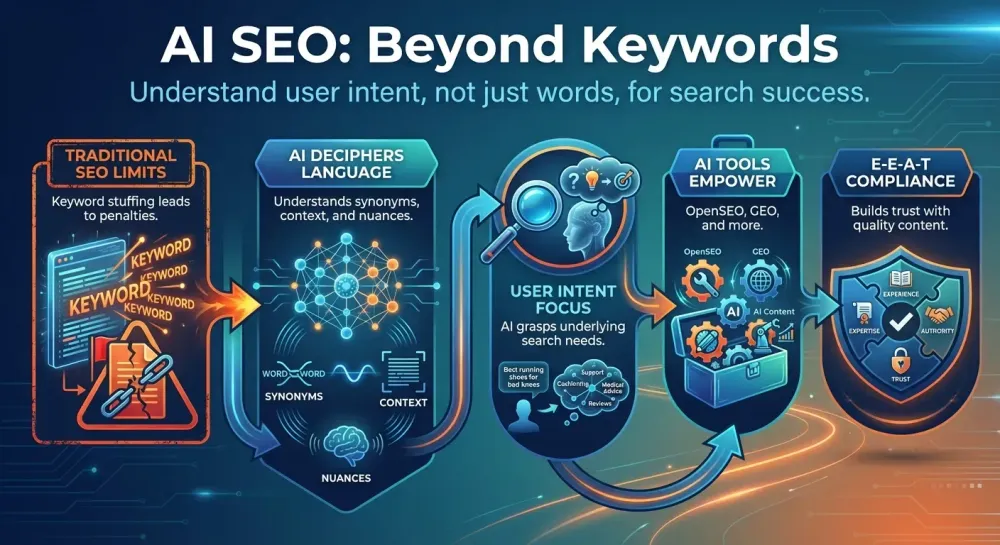
Search engines are no longer mere indexers of text. They are becoming sophisticated interpreters of context and user intent. This means understanding not just what a user is searching for, but why. The focus has shifted decisively towards delivering genuinely valuable and relevant content that directly addresses the user's underlying need, moving beyond simple keyword matching.
The Limitations of Keyword-Centric SEO
An over-reliance on traditional keyword-centric SEO can lead to thin, repetitive content that fails to satisfy users. This approach often results in a poor user experience and can be detrimental to a website's long-term standing. The rise of advanced generative AI models further underscores the need for a more nuanced strategy.
Introducing GEO: The Next Frontier
This evolving landscape necessitates a new paradigm: Generative Engine Optimization (GEO). GEO focuses on creating content that is not only discoverable by traditional search engines but also optimized for understanding and recommendation by AI-driven platforms. Tools like OpenSEO are at the forefront of this movement, offering AI-powered solutions that aid in intelligent keyword research, deep article generation, and comprehensive SEO scoring, ensuring content meets both user and emerging AI engine demands. This strategic shift is crucial for future search visibility.
Understanding GEO: What It Is and Why It Matters
In today's rapidly evolving digital landscape, the way users discover content is undergoing a significant transformation. Traditional SEO practices are no longer sufficient on their own. This shift necessitates a new approach to content optimization, one that aligns with the capabilities of emerging AI-driven platforms.
Defining Generative Engine Optimization (GEO)
Generative Engine Optimization (GEO) is the strategic practice of optimizing content not just for traditional search engines but also for AI-driven search and recommendation engines. This involves a deeper understanding of how AI models process information. GEO emphasizes semantic relevance, natural language understanding, and contextual depth to ensure content is not only found but also understood and valued by these advanced systems. Tools like OpenSEO are pioneering this by integrating GEO principles, aiming to make content discoverable by both established search giants and next-generation AI interfaces.
How GEO Differs from Traditional SEO
While traditional SEO heavily relied on keyword density and backlinks, GEO incorporates these foundational elements while adding crucial new layers. Traditional methods focused on matching keywords to queries. GEO, however, delves into the semantic meaning and context of content, ensuring it resonates with AI's ability to comprehend nuance and intent. OpenSEO, for instance, aids in this by generating content with structured layouts and semantic connections, preparing it for AI interpretation.
The Role of AI in Modern Search
Generative AI models, such as those powering platforms like ChatGPT and Gemini, are increasingly becoming primary interfaces for information discovery. Users are turning to these conversational AI systems for answers, summaries, and content generation. This means brands and content creators must adapt their SEO strategies to be visible within these new ecosystems.
The Impact of Generative AI on Content Discovery
The rise of generative AI fundamentally alters how users find information. Brands need to ensure their content is not only optimized for search engines but also for the sophisticated algorithms of AI platforms. By focusing on GEO, content can be crafted to be easily understood and recommended by these emerging technologies, securing a vital presence in the future of online discovery.
Key Pillars of GEO Mastery
In today's dynamic digital landscape, achieving true GEO (Generative Engine Optimization) mastery requires a strategic shift beyond traditional SEO. It's about understanding the evolving ways search engines and AI interact with content, and proactively optimizing for both. This involves a deeper dive into user intent, leveraging cutting-edge AI tools for efficiency, and ensuring content resonates with both algorithms and human readers.
Intelligent Content Strategy: From Keywords to Concepts
The era of keyword stuffing is long gone. Modern SEO, and by extension GEO, demands a move towards understanding user problems and providing comprehensive, value-driven solutions. This means delving beyond simple keyword research to grasp the underlying intent and context of search queries. Tools like OpenSEO excel here, not just by identifying high-volume, low-competition keywords, but by helping to map these to broader conceptual clusters. This ensures content addresses the full spectrum of a user's needs, fostering deeper engagement and demonstrating expertise. The focus shifts from simply ranking for a term to becoming the definitive resource for a topic.
Practical Implications: Content needs to be structured around user needs and questions, not just isolated keywords.
Actionable Tip: Map your primary keywords to broader topic clusters and create content that comprehensively answers related questions.
AI-Powered Content Creation: Efficiency and Quality
Leveraging AI has become indispensable for efficient and high-quality content generation. Platforms such as OpenSEO offer a powerful solution, integrating advanced AI models to streamline the creation process. By inputting a topic or keywords, users can generate structured, logical, and semantically rich articles. OpenSEO's AI is trained on vast datasets of high-ranking content, inherently understanding what makes content "search engine friendly" and aligned with E-E-A-T principles. This AI-driven approach accelerates content production significantly, allowing marketers and businesses to scale their efforts while maintaining a high standard of output.
Practical Implications: AI tools can significantly speed up content creation while adhering to quality and SEO best practices.
Actionable Tip: Utilize AI content generation tools like OpenSEO to produce well-structured and semantically rich articles efficiently.
Semantic Richness and Contextual Depth
Ensuring AI-generated content possesses semantic richness and contextual depth is paramount for GEO success. This involves more than just grammatical correctness; it's about creating content that flows logically, connects ideas seamlessly, and provides a comprehensive understanding of the subject matter. OpenSEO addresses this by automatically structuring articles with appropriate H-tags and bolding key phrases, enhancing readability for both AI crawlers and human users. The goal is to create content that is not only informative but also deeply contextual, allowing search engines to accurately interpret its relevance and value.
Practical Implications: Content must be logically structured and connect ideas to provide a deep understanding of the topic.
Actionable Tip: Focus on creating content with clear headings, subheadings, and bolded key phrases to improve both AI and human comprehension.
User Experience and Engagement as Ranking Factors
Ultimately, content that ranks well is content that users find valuable and engaging. Prioritizing user experience is no longer a secondary concern but a direct ranking factor. Metrics like time on page and bounce rate serve as crucial indicators of content quality and relevance. OpenSEO's integrated SEO scoring system provides actionable feedback on readability, content depth, and keyword integration, helping to optimize for these engagement signals. Furthermore, the emphasis on E-E-A-T (Experience, Expertise, Authoritativeness, Trustworthiness) is critical, especially for AI-driven content, ensuring it meets the highest standards of credibility and user satisfaction.
Practical Implications: User engagement metrics are direct indicators of content quality and relevance for search engines.
Actionable Tip: Optimize content for readability and ensure it demonstrates E-E-A-T principles to foster user trust and engagement.
Practical Implementation with OpenSEO
In today's dynamic digital landscape, achieving significant SEO success requires a sophisticated approach to content creation and optimization. OpenSEO emerges as a comprehensive AI SEO traffic growth engine, designed to streamline these complex processes. It empowers users to produce high-quality, search-engine-friendly content efficiently, ensuring maximum visibility and engagement in a competitive online environment.
Streamlining Your Content Workflow with OpenSEO
OpenSEO revolutionizes content production by offering an end-to-end solution. Its core functionality simplifies the entire content lifecycle, from initial ideation to final publication. This integrated approach means users spend less time on manual tasks and more time on strategy, ultimately accelerating their SEO efforts and driving organic traffic growth.
Smart Keyword Research for the GEO Era
Moving beyond traditional keyword analysis, OpenSEO's intelligent keyword research tools are crucial for navigating the current SEO landscape. The platform helps users identify high-potential, low-competition long-tail keywords. This strategic approach ensures that content is not only discoverable but also targets specific user intent, a critical factor for both traditional search engines and emerging Generative Engine Optimization (GEO) strategies.
AI-Assisted Content Generation: Beyond Basic Writing
OpenSEO's AI goes far beyond rudimentary text generation. It crafts structured, in-depth articles with optimized formatting, automatically incorporating elements like H-tags and bolding to enhance readability and SEO performance. This AI-assisted approach ensures that generated content is comprehensive, well-organized, and aligned with best practices for search engine algorithms.
Optimizing for AI Recommendations: The OpenSEO Advantage
A key differentiator for OpenSEO is its focus on GEO. The platform optimizes content structure and semantic connections specifically for AI engines, ensuring your brand is more likely to be recommended. This forward-thinking strategy positions users to capture future search traffic by aligning content with how AI systems understand and process information.
Seamless Integration: WordPress and Beyond
The benefits of OpenSEO extend to practical publishing. Its seamless WordPress integration allows for automated content publishing, eliminating manual copy-pasting. This feature, along with an article scoring system for continuous improvement, enables data-driven optimization and a scalable approach to maintaining a robust SEO presence.
The Future of Search and Your Brand's Visibility
In today's rapidly evolving digital landscape, staying ahead in SEO is paramount for brand visibility. The continuous evolution of search algorithms necessitates ongoing adaptation, making a proactive approach essential for long-term success.
Anticipating Algorithmic Shifts
Search engines are constantly refining how they rank content. This means strategies that work today might be less effective tomorrow. Brands must embrace a dynamic mindset, continuously monitoring changes and adjusting their SEO tactics to maintain their online presence and ensure their content remains discoverable.
Building Brand Authority in an AI-Dominated Landscape
As AI plays an increasingly significant role in content discovery and generation, building genuine brand authority becomes crucial. This involves creating high-quality, valuable content that resonates with users and establishes expertise. Investing in SEO now, especially with tools that understand AI-driven optimization, helps build lasting brand authority that transcends temporary algorithm tweaks.
The Long-Term Benefits of Embracing GEO
Embracing GEO (Generative Engine Optimization) strategies, which focus on optimizing content for AI engines like ChatGPT and Gemini, is key. This forward-thinking approach positions brands for future search traffic and AI-driven discovery. Investing in GEO now ensures your brand is discoverable not just by traditional search engines but also by emerging AI platforms, securing a competitive edge.
Staying Ahead of the Curve
The importance of a holistic approach to content and SEO cannot be overstated. Continuous learning and experimentation are key to long-term success. By integrating advanced AI solutions for content creation and SEO analysis, brands can efficiently produce optimized content that meets both user needs and search engine requirements, ultimately driving sustained visibility and traffic.
FAQ (Frequently Asked Questions)
Q1: What is Generative Engine Optimization (GEO)?
A1: GEO, or Generative Engine Optimization, is an advanced SEO strategy that focuses on optimizing content not only for traditional search engines but also for AI-driven search and recommendation systems. It emphasizes semantic relevance, contextual depth, and natural language understanding to ensure content is comprehensible and valued by AI models.
Q2: How does GEO differ from traditional keyword-focused SEO?
A2: Traditional SEO primarily relied on keyword density and backlinks. GEO builds upon these foundations by incorporating a deeper understanding of user intent, semantic meaning, and the contextual relationships within content. It aims to make content discoverable and recommendable by AI, which goes beyond simple keyword matching.
Q3: Can AI tools like OpenSEO genuinely improve my search engine rankings?
A3: Yes, AI tools like OpenSEO can significantly improve your rankings by streamlining content creation, identifying intelligent keyword opportunities, and optimizing content structure and semantic richness for both human readers and AI algorithms. This leads to higher quality, more relevant content, which is a key factor in modern SEO success.
Q4: Is GEO important for small businesses, or is it only for large enterprises?
A4: GEO is crucial for businesses of all sizes. As AI becomes more integrated into how users find information, even small businesses need to adapt to remain competitive. GEO helps ensure that your content is discoverable and relevant in this evolving landscape, leveling the playing field.
Conclusion
The landscape of SEO has irrevocably shifted. As we've explored, the era of solely optimizing for traditional keywords is rapidly fading, replaced by the imperative to master GEO – the new frontier of search. This transition demands a fundamental re-evaluation of our SEO strategies, moving beyond superficial keyword stuffing to embrace a holistic approach. The core of this evolution lies in crafting comprehensive content strategies that prioritize semantic richness, genuine user experience, and the intelligent integration of AI for efficient, high-quality content creation.
The future of discoverability hinges on this ability to understand and cater to the nuanced, context-aware queries that generative AI models are increasingly processing. Therefore, to not just survive but thrive in tomorrow's search ecosystem, businesses must proactively adopt these advanced methodologies. Don't let your brand be left behind. Start by auditing your current content for semantic depth and user engagement. Explore AI-powered tools designed to elevate your content creation process, ensuring it resonates with both traditional search engines and the AI systems that are shaping information discovery.
Take the first step today: Embrace the power of GEO and transform your SEO approach. Explore solutions like OpenSEO to gain a competitive edge and ensure your content isn't just found, but actively recommended in the evolving world of search. The time to master GEO is now.