SEO Tools 2026: Adapting to AI Search & User Intent
The Shifting Sands of Search: AI's Ascendancy and Evolving User Intent
The digital landscape is in constant flux, with Artificial Intelligence rapidly reshaping how users find information and how businesses establish their online presence. As we look towards 2026, the evolution of search is marked by the increasing sophistication of AI, demanding a strategic recalibration for SEO professionals and their tools.
The Rise of Generative AI in Search
Advanced AI models are no longer confined to backend operations; they are now integral to the search engine results pages (SERPs) themselves. This integration signifies a profound shift, moving beyond rudimentary keyword matching. Tools and platforms are emerging that leverage AI to understand the nuances of user queries, interpret context, and even anticipate needs. This AI-driven approach is fundamentally altering the search experience, offering more direct answers and synthesized information.
Understanding Nuanced User Intent
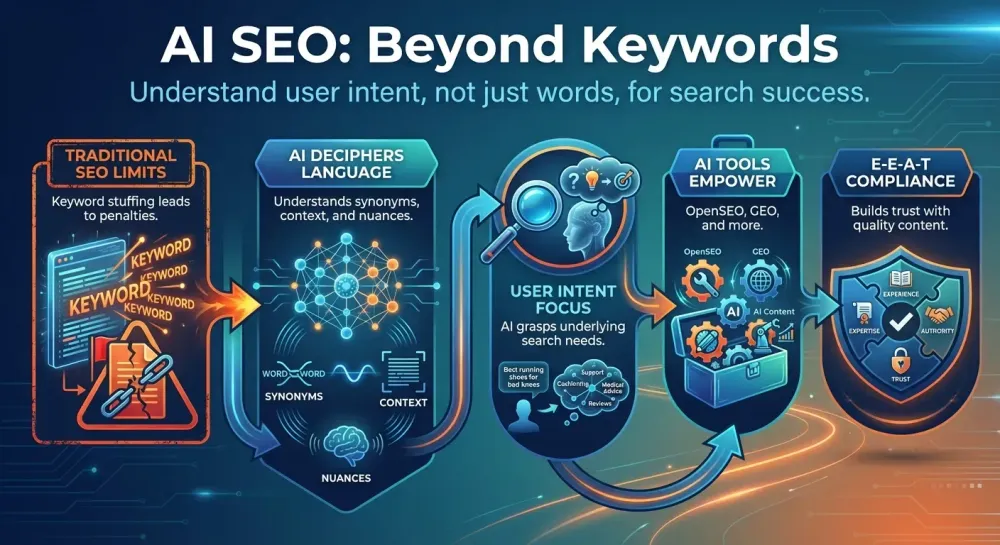
AI-powered search is adept at deciphering complex, conversational queries that traditional keyword-based systems struggle with. It grasps the underlying intent, the context of a user's search journey, and the specific information they are truly seeking. This deeper comprehension means that simply optimizing for keyword density is becoming a relic of the past.
The Limitations of Traditional SEO Approaches
Consequently, the efficacy of traditional SEO tools and strategies is being tested. While keyword research and on-page optimization remain foundational, relying solely on these methods is insufficient. The challenge for SEO tools in 2026 lies in their ability to adapt to AI's advanced interpretation of user intent. As AI increasingly drives search results, the focus must shift towards creating content that is not only keyword-rich but also contextually relevant, authoritative, and genuinely valuable to the user's evolving needs. This necessitates a move towards more sophisticated analysis and content generation capabilities, as seen in emerging AI SEO solutions.
Core Adaptations for SEO Tools in 2026: Beyond Keyword Research
The evolution of search engines and user behavior is rapidly reshaping the SEO landscape, pushing seo tools 2026 to move beyond rudimentary keyword tracking. In the coming years, sophisticated AI integration will be paramount, enabling a deeper understanding of user intent and predictive capabilities. Tools are shifting from mere data aggregators to intelligent partners that guide content strategy and creation.
AI-Powered Keyword Discovery and Semantic Analysis
Future-forward SEO tools are increasingly adept at deciphering the nuances of user queries, identifying not just keywords but the underlying intent and thematic connections. This shift means tools are moving beyond simple volume and competition metrics to map out comprehensive topical clusters. For instance, platforms like OpenSEO are pioneering intelligent keyword research, offering capabilities to uncover high-volume, low-competition long-tail keywords that directly address specific user needs. This semantic understanding ensures content resonates with both users and the ever-evolving algorithms that power search.
Content Generation and Optimization for AI Understanding
The role of AI in content creation is expanding dramatically. Seo tools 2026 are integrating advanced AI models, trained on vast datasets of high-ranking content, to generate comprehensive, structured, and semantically rich material. These tools aim to produce content that not only appeals to human readers but also adheres to the standards and signals that AI algorithms prioritize. OpenSEO, for example, emphasizes its AI's ability to generate well-structured articles with appropriate H-tags and bolded key phrases, ensuring high readability and SEO efficacy. Crucially, these models are increasingly trained to meet stringent quality standards like E-E-A-T (Experience, Expertise, Authoritativeness, Trustworthiness), making content more likely to be recognized and favored by search engines.
Predictive Analytics and Trend Forecasting
A significant advancement in seo tools 2026 will be their capacity for predictive analytics and trend forecasting. By analyzing vast amounts of data, these tools can identify emerging search trends and inform content strategy proactively, allowing businesses to stay ahead of the curve. This foresight enables marketers to create relevant content before a trend reaches its peak, capturing early search interest. The integration of generative AI engines, as seen with OpenSEO’s GEO (Generative Engine Optimization), further enhances this by optimizing content for potential recommendation by AI search interfaces, securing future traffic sources.
| SEO Tool Advancement | Core Functionality | Key Benefit |
|---|---|---|
| AI Keyword Discovery | Intent & Cluster Mapping | Deeper user understanding |
| AI Content Generation | Structured & Semantic Output | Enhanced AI & user appeal |
| Predictive Analytics | Trend Forecasting | Proactive strategy development |
GEO (Generative Engine Optimization): The Next Frontier for SEO Tools
The search landscape is rapidly evolving, with generative AI models poised to redefine how users discover information. To navigate this shift, a new strategic approach is emerging: Generative Engine Optimization (GEO). This marks a significant evolution for SEO tools in 2026, moving beyond traditional keyword rankings to focus on how content is understood and recommended by AI. Tools are adapting to help brands become discoverable by these new AI engines, ensuring future search traffic.
Optimizing for Generative AI Models
As AI models like ChatGPT and Gemini become central to information retrieval, SEO tools are being retooled. The focus now is on ensuring content is not just keyword-rich, but also contextually relevant and semantically coherent. Tools such as those listed in recent analyses, including Semrush, Search Atlas, and Ahrefs, are integrating AI capabilities to assist in creating content that AI engines can readily process and cite. This involves optimizing for clear language, logical flow, and factual accuracy, qualities that generative AI prioritizes when curating answers.
Structured Data and Semantic Markup
The critical role of structured data and semantic markup cannot be overstated in the age of AI search. These elements provide AI engines with a clear understanding of the context and relationships within content. By employing schema markup and other semantic technologies, brands can help AI models accurately interpret entities, events, and their connections. SEO tools can assist in identifying opportunities to implement this markup, ensuring that content is not only found but also deeply understood by generative AI, leading to more precise recommendations.
Brand Authority and Trust Signals in AI Search
In a landscape where AI curates information, brand authority and trust signals become paramount. When generative AI synthesizes information, it often prioritizes sources that demonstrate expertise, authoritativeness, and trustworthiness (E-E-A-T). SEO tools are evolving to help brands bolster these signals. OpenSEO, for instance, is specifically focusing on GEO to help brands get discovered by AI. By assisting in the creation of high-quality, authoritative content and ensuring its semantic clarity, OpenSEO aims to secure future search traffic by making brands visible and trusted within AI-driven discovery.
Evaluating SEO Tools in 2026: Practical Considerations and Value
As we navigate the evolving digital landscape of 2026, selecting the right SEO tools requires a discerning approach, moving beyond mere hype to focus on tangible business value. The proliferation of AI-driven solutions demands a critical assessment of their practical application and their ability to integrate seamlessly into existing workflows.
Beyond Hype: Identifying True Value
In 2026, the criteria for evaluating SEO tools must center on their capacity to deliver measurable results. While AI capabilities are increasingly sophisticated, their true worth lies in how effectively they contribute to business objectives. Tools that offer predictive analytics and sophisticated content generation, like OpenSEO, demonstrate value by enabling users to proactively identify high-potential keywords and produce SEO-optimized content that resonates with both search engines and users. The focus shifts from the novelty of AI to its actual impact on search performance and traffic growth.
Integration and Workflow Automation
The true power of modern SEO tools is unlocked through seamless integration. For instance, OpenSEO's WordPress integration exemplifies this, allowing for automated content publishing directly to a website. This feature significantly reduces manual effort, streamlining the content creation and deployment process. Automation features are crucial for scaling content production efficiently, enabling marketing teams to focus on strategy rather than repetitive tasks, thus maximizing the utility of SEO tools in 2026.
Cost-Effectiveness and ROI in SEO Tool Investments
Assessing the return on investment (ROI) for SEO tools in 2026 is paramount. This involves not only scrutinizing subscription costs but also quantifying the business impact of improved search performance. Industry discussions frequently highlight the need to test workflows and directly connect tool usage to key business outcomes, such as increased organic traffic, higher conversion rates, and enhanced brand visibility. Tools that facilitate this direct correlation, like those offering comprehensive analytics and reporting, prove their worth by demonstrating a clear path to profitability.
User Experience and Ethical Considerations in AI-Driven SEO
As we look towards seo tools 2026, the integration of AI is fundamentally reshaping how we approach search engine optimization, placing a premium on user experience and ethical practices.
The User-Centricity of AI Search
AI search engines are increasingly prioritizing user satisfaction, meaning content must be not only discoverable but also genuinely valuable and engaging. This necessitates a shift towards creating user-centric content that directly addresses search intent and provides comprehensive answers. Tools like OpenSEO are designed to facilitate this by assisting in the creation of content that resonates with both algorithms and human readers.
Ensuring Content Quality and Accuracy
The role of AI-powered seo tools 2026 extends beyond mere optimization; they are crucial for ensuring that generated content is accurate, readable, and deeply informative. OpenSEO's article scoring system exemplifies this by evaluating content from multiple angles, including keyword density and readability, and providing actionable suggestions for improvement. This mechanism helps maintain high standards, ensuring that AI-assisted content is a reliable source of information.
Data Privacy and Security in SEO Tool Usage
When utilizing advanced seo tools 2026, especially those handling sensitive business data, addressing data privacy and security is paramount. Users must be assured that their proprietary information is protected. Furthermore, the ethical implications of AI in content creation, including transparency about AI assistance, are critical for maintaining trust and integrity in the digital landscape.
The Future Landscape: Emerging Trends and Tool Evolution
The search engine optimization landscape is rapidly transforming, with seo tools 2026 poised to be more sophisticated and integrated than ever. Anticipating these shifts is crucial for sustained success.
Personalized Search and AI Assistants
Expect search results to become hyper-personalized, driven by advanced AI and individual user data. The rise of AI assistants and voice search will necessitate SEO tools that can adapt to conversational queries and provide immediate, context-aware answers.
The Convergence of SEO and Other Marketing Disciplines
SEO is no longer a siloed discipline. Its integration with content marketing, social media, and paid advertising will deepen. This necessitates seo tools 2026 that offer cross-channel insights and facilitate unified campaign strategies.
The Continuous Evolution of SEO Tools
The development of seo tools 2026 will focus on predictive analytics, advanced automation, and deeper AI integration. Staying agile and continuously evaluating new tools and strategies will be key to remaining competitive in this dynamic ecosystem.
FAQ (Frequently Asked Questions)
Q1: How is AI changing the fundamental approach to SEO in 2026?
A1: AI is shifting SEO from a keyword-centric approach to one that prioritizes understanding and fulfilling nuanced user intent. This means focusing on context, semantic relevance, and creating content that directly answers complex queries, rather than just optimizing for specific search terms.
Q2: What is Generative Engine Optimization (GEO) and why is it important for SEO tools in 2026?
A2: GEO is an emerging strategy focused on optimizing content for discovery and recommendation by generative AI models. It's crucial because AI is increasingly acting as a primary information curator, and GEO helps ensure content is understood, trusted, and cited by these advanced AI systems, securing future search traffic.
Q3: How can I evaluate if an SEO tool is truly valuable in the AI-driven landscape of 2026?
A3: Look beyond the AI hype. True value lies in measurable results. Evaluate tools based on their ability to provide predictive analytics, automate workflows, enhance content quality for AI understanding, and demonstrate a clear ROI through improved search performance and business outcomes.
Q4: What are the key ethical considerations when using AI-powered SEO tools?
A4: Key ethical considerations include ensuring data privacy and security for your business information, maintaining transparency about the use of AI in content creation, and upholding content accuracy and quality standards to build and maintain user trust.
Conclusion: Embracing the AI Revolution in SEO
The landscape of search is undergoing a profound transformation, driven by the relentless march of artificial intelligence. As we look towards 2026, SEO tools are no longer mere assistants but indispensable intelligent partners, evolving beyond rudimentary keyword tactics. They are becoming sophisticated engines capable of deciphering nuanced user intent, empowering the creation of high-quality, AI-optimized content, and even forecasting emergent search trends. Tools like OpenSEO, with their innovative GEO functionalities, seamless integrations, and AI-powered content generation and scoring, exemplify this critical evolution, placing them at the vanguard of this paradigm shift.
To thrive in this AI-driven era, businesses and marketers must actively embrace these advancements. This means investing in SEO tools 2026 that prioritize deep user intent analysis, facilitate the production of genuinely valuable and engaging content, and offer predictive insights. Actionable recommendations include rigorously evaluating SEO tools based on their AI capabilities, integration potential, and ethical AI practices. Moreover, prioritize learning and adapting to AI's evolving role in search. The future of visibility is intrinsically linked to our ability to harness AI. Take action now: explore the next generation of SEO tools, understand their AI-driven functionalities, and begin integrating them into your strategy. By doing so, you will not only ensure your content connects with your target audience in 2026 but will also secure a commanding presence in the search engines of tomorrow.