SEO Tools 2026: Shape Your Content Creation
This article is your essential guide to understanding how these next-generation SEO tools will revolutionize your entire content creation journey. We'll explore how they'll empower your initial brainstorming, refine your keyword strategies, supercharge your AI-assisted writing, streamline optimization, and ultimately, make your publishing process more effective than ever before. Prepare to unlock new levels of efficiency and impact in your online presence.
The Evolving Landscape of SEO Tools: What's New for 2026?
The realm of SEO tools is undergoing a significant transformation, moving beyond traditional metrics to embrace artificial intelligence and predictive capabilities. As we look towards 2026, the emphasis is shifting towards proactive strategies and a deeper understanding of user experience, driven by the rapid advancement of AI. This evolution presents both opportunities and challenges, with rising costs and AI hype necessitating careful evaluation of new SEO tools 2026.
Beyond Traditional Metrics: The Rise of AI and Generative Optimization
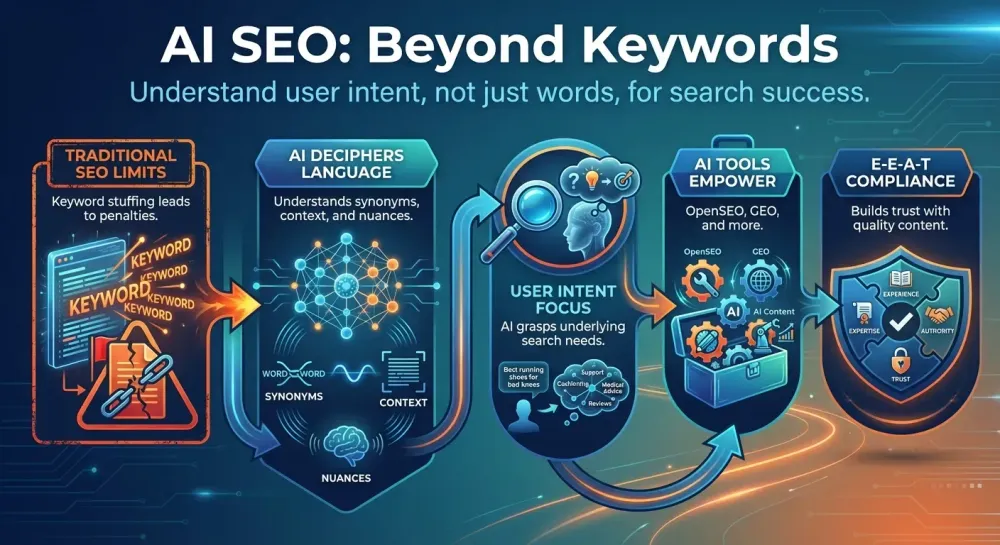
The rapid advancement of AI is fundamentally changing how SEO tools operate. In 2026, tools will increasingly leverage AI not just for analysis but for generative optimization. This means AI will be instrumental in creating content that is not only search engine friendly but also optimized for AI-powered discovery platforms, a key trend highlighted by solutions like OpenSEO. OpenSEO, for instance, focuses on Generative Engine Optimization (GEO) by training AI models on high-ranking content, ensuring they understand search engine preferences and E-E-A-T standards. This shift moves SEO tools from merely reporting data to actively shaping content strategy for future search environments.
Predictive Analytics and Proactive Strategies
By 2026, SEO tools will be moving from reactive analysis to proactive, predictive insights. Instead of simply reporting on past performance, tools will offer foresight into potential ranking changes and user behavior trends. This allows for proactive strategy development, enabling businesses to anticipate shifts and adapt their SEO efforts before they become critical. The goal is to stay ahead of the curve, as suggested by the anticipation of tools offering predictive analytics and AI-driven automation.
The Growing Importance of User Experience (UX) in SEO
The focus will shift towards optimizing for both search engines and AI-powered discovery platforms, with user experience signals becoming increasingly crucial for ranking. Tools in 2026 will likely offer more sophisticated ways to measure and improve UX metrics, recognizing that a positive user journey is paramount for long-term SEO success. The challenge of rising costs and AI hype necessitates careful tool evaluation to ensure investments deliver tangible business value.
AI-Powered Content Creation: From Keyword Research to Generation
The landscape of content creation is rapidly evolving, with AI at its forefront. As we look towards 2026, sophisticated SEO tools are integrating advanced artificial intelligence to streamline and enhance every stage of content production. This shift promises greater efficiency and effectiveness in reaching target audiences, moving beyond traditional search engine optimization to encompass the growing influence of generative AI.
Intelligent Keyword Research: Unearthing High-Potential Long-Tail Keywords
Manual keyword research, while still valuable, can be time-consuming and prone to missing niche opportunities. Tools like OpenSEO are integrating advanced AI for sophisticated keyword analysis. This allows for the identification of high-potential long-tail keywords that might be overlooked by traditional methods. By analyzing search intent and competition more deeply, these AI-powered SEO tools 2026 can uncover valuable phrases that drive targeted traffic, ensuring content is built on a solid foundation of audience interest. This intelligent approach moves beyond simple volume metrics to understand the nuances of user queries.
AI-Driven Article Generation: Structure, Depth, and Readability
The ability of AI to generate comprehensive, well-structured articles is a significant leap forward. Modern AI writing assistants can now produce content that includes proper H-tag placement, logical flow, and emphasis on key phrases. This dramatically speeds up the drafting process, allowing content creators to focus on strategy and refinement rather than initial writing. OpenSEO, for instance, leverages AI to generate articles with inherent readability and SEO best practices baked in, significantly reducing the time from ideation to publication.
Optimizing for Generative AI Engines (GEO): The Future of Content Discovery
A new paradigm is emerging: Generative Engine Optimization (GEO). This concept shifts the focus from solely optimizing for traditional search algorithms to creating content that appeals to AI models themselves. This means content needs to be not only informative and keyword-rich but also semantically rich and meticulously structured for AI comprehension. The goal is to ensure content is discoverable by future AI-driven search interfaces and recommendation engines. As OpenSEO highlights, this involves optimizing content structure and semantic relevance to be more easily understood and surfaced by AI, positioning brands for future search dominance.
The integration of AI into SEO tools 2026 is transforming content creation from a labor-intensive process into a more intelligent and automated workflow. By embracing AI-powered keyword research and article generation, and by understanding the principles of GEO, businesses can ensure their content is not only found by users but also by the AI systems that will increasingly mediate discovery.
Ensuring Content Quality and Performance: AI-Assisted Optimization
In the evolving digital landscape of 2026, the effectiveness of content hinges on its quality and performance. As search engine algorithms and user expectations mature, sophisticated SEO tools 2026 are emerging to streamline content creation and optimization. These tools leverage AI to not only generate content but also to rigorously evaluate and refine it, ensuring it meets stringent standards before publication.
Data-Driven Content Scoring and Feedback
By 2026, advanced SEO tools 2026 will feature robust scoring systems. These platforms, like OpenSEO, will evaluate content across multiple critical dimensions, including keyword density, readability scores, and content depth. This granular analysis moves beyond simple keyword stuffing, offering actionable recommendations. For instance, a tool might flag a section for lacking sufficient detail or suggest improvements to sentence structure for better flow. This pre-publication feedback loop is crucial for producing content that resonates with both search engines and readers, directly impacting organic visibility and engagement.
Meeting E-E-A-T Standards with AI Assistance
Achieving high rankings in 2026 increasingly depends on adhering to search engine quality guidelines, particularly E-E-A-T (Experience, Expertise, Authoritativeness, Trustworthiness). AI models, when trained on vast datasets of high-ranking content, are inherently designed to align with these principles. They can help structure content logically, incorporate relevant terminology, and even suggest areas where additional authoritative sources could be cited. While AI provides a powerful framework, human oversight remains indispensable.
Balancing AI Generation with Human Oversight
The synergy between AI and human expertise will define exceptional content creation in 2026. While AI excels at rapid generation, optimization, and adherence to technical SEO best practices, human editors are vital for injecting factual accuracy, maintaining a consistent brand voice, and ensuring nuanced understanding of complex topics. The OpenSEO platform exemplifies this, offering AI-driven generation and scoring, but ultimately, a human touch is needed to guarantee the content's authenticity and strategic alignment. This collaborative approach ensures that content is not only technically sound but also genuinely valuable and trustworthy.
Streamlining Workflows: Automation and Integration
As we look towards 2026, the landscape of SEO tools is rapidly evolving, emphasizing efficiency and intelligent automation. The focus is shifting from manual execution to strategic oversight, driven by advanced AI capabilities and seamless integration with existing content management systems. This evolution promises to redefine how content is created, optimized, and published, ultimately connecting SEO efforts more directly to tangible business outcomes.
Seamless Platform Integrations: WordPress and Beyond
The days of tedious copy-pasting are numbered. Leading SEO tools in 2026 are increasingly offering direct integrations with popular CMS platforms like WordPress. This allows for a fluid transfer of optimized content, eliminating manual errors and saving valuable time. Tools are designed to work harmoniously with your existing infrastructure, ensuring a smooth transition and immediate productivity gains.
Automating Content Publishing and Management
Expect features like one-click publishing, automatic image setting, and intelligent tag/category assignment to become standard. These automations empower content creators to shift their focus from repetitive execution to higher-level strategy and creative ideation. By handling the granular tasks, these advanced SEO tools free up resources, allowing teams to concentrate on developing innovative campaigns and analyzing performance trends.
Connecting SEO Efforts to Business Value
A critical evaluation point for SEO tools in 2026 will be their ability to demonstrate a clear return on investment (ROI). This means connecting SEO outputs directly to core business objectives, such as lead generation, sales conversions, and customer acquisition cost reduction. The capacity to test workflows, measure their impact on these key performance indicators, and provide actionable insights will be paramount for justifying investment in SEO technology. For instance, platforms like OpenSEO are already integrating AI-driven content generation with WordPress, allowing users to research keywords, generate optimized articles, and publish them directly, streamlining the entire process and making ROI tracking more straightforward.
Choosing the Right SEO Tools for 2026: A Strategic Approach
As we navigate the evolving digital landscape, selecting the right SEO tools for 2026 requires a more strategic mindset than ever before. The proliferation of AI-driven solutions, while promising, necessitates a critical evaluation beyond mere marketing hype. Focusing on practical application and demonstrable Return on Investment (ROI) will be paramount for businesses and individuals alike.
Evaluating Tools Beyond Hype: Focus on Functionality and ROI
The surge of AI in the SEO space means it's crucial to evaluate platforms like OpenSEO based on their practical application and demonstrable value, not just their marketing claims. For instance, OpenSEO's core function of AI-driven content generation, coupled with its intelligent keyword research and article scoring system, directly addresses the need for efficient, high-quality content creation. This focus on tangible outputs—better keyword targeting, structured content, and data-backed optimization—aligns with the business imperative of proving ROI from SEO investments.
Key Features to Look For in Next-Gen SEO Platforms
When seeking the best SEO tools 2026, look for platforms that offer a comprehensive suite of features, from advanced keyword research and AI generation to robust analytics and seamless integrations. OpenSEO exemplifies this with its "GEO (Generative Engine Optimization)" for emerging AI search engines and its seamless WordPress integration. These capabilities are vital for a holistic SEO strategy, ensuring that content is not only discoverable by traditional search engines but also optimized for the evolving AI-powered search ecosystem.
Budgeting Wisely: Avoiding Common Pitfalls
Be wary of rising prices and understand precisely what you're paying for. A tiered pricing model or a focus on specific functionalities might be more cost-effective than a one-size-fits-all approach. Consider the specific needs of your business or personal brand—are you a solo blogger, a content marketer, or an enterprise team? Prioritize tools that offer a clear path to improving your content creation process and driving measurable SEO results, ensuring that every dollar spent on SEO tools contributes directly to your bottom line.
FAQ (Frequently Asked Questions)
Q1: How will AI change keyword research by 2026?
A1: By 2026, AI-powered SEO tools will move beyond simple volume metrics to offer deeper insights into search intent and user behavior. They will be instrumental in identifying high-potential long-tail keywords and understanding semantic relevance, leading to more targeted and effective content strategies.
Q2: What is Generative Engine Optimization (GEO)?
A2: Generative Engine Optimization (GEO) is a new approach to SEO that focuses on creating content optimized for AI-driven discovery platforms and search engines. It involves structuring content semantically and ensuring it's easily understood and surfaced by AI models, going beyond traditional keyword optimization.
Q3: Will AI replace human content creators by 2026?
A3: No, AI will not replace human content creators. Instead, it will act as a powerful assistant, automating repetitive tasks like initial drafting and optimization. Human oversight will remain crucial for ensuring factual accuracy, brand voice, and nuanced understanding of complex topics, fostering a collaborative content creation process.
Q4: How can I ensure the SEO tools I choose in 2026 deliver a good ROI?
A4: To ensure a good ROI, focus on tools that offer practical applications and demonstrable value, rather than just marketing hype. Look for features like AI-driven content generation, robust analytics, seamless integrations with your existing CMS, and the ability to connect SEO efforts directly to business objectives like lead generation and sales conversions.
Conclusion
The landscape of content creation is undergoing a profound transformation, and the SEO tools of 2026 are at the vanguard of this revolution. As we've explored, these aren't mere evolutionary steps, but a fundamental paradigm shift, driven by the potent synergy of AI-powered insights, sophisticated generative capabilities, and seamless integrations. By embracing these advancements, creators can transcend previous limitations, unlocking unparalleled efficiency and effectiveness in their content strategies. Platforms like OpenSEO stand as prime examples of this future, offering a comprehensive ecosystem for intelligent keyword research, AI-driven content generation with precise GEO optimization, and robust data-driven quality scoring. To thrive in the coming years, the strategic selection and adept implementation of these next-generation SEO tools 2026 will be your most critical differentiator.
Therefore, we urge you to proactively explore and integrate these cutting-edge solutions into your workflow. Don't wait for the future; build it. Begin by researching platforms that offer the integrated AI and data-driven features discussed. Experiment with their generative capabilities and analyze the insights they provide. The time to adapt and innovate is now. Embrace the power of SEO tools 2026 and position yourself to not only dominate search engine results but to achieve sustainable organic growth for years to come.